


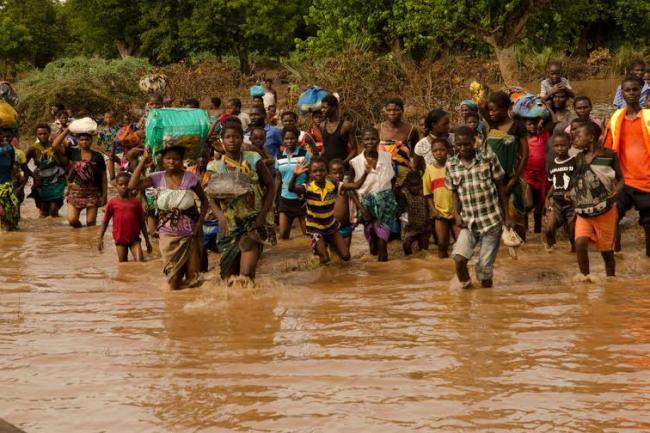
After intense flooding, Malawi desperately needs scale-up in international aid–UN experts
In a press release, the Special Rapporteur on the human rights of internally displaced persons, Chaloka Beyani, the Special Rapporteur on the right to food, Hilal Elver, and the Special Rapporteur on the human right to safe drinking water and sanitation, Léo Heller, encouraged the international community to do “everything possible to meet the current serious shortfall in funds and provision of essential aid,” especially as only a quarter of the urgently required $81 million of a Preliminary Response Plan had been received to date.
“The flooding has displaced large numbers of people and presents massive and complex challenges for Governments and their humanitarian allies in the short, medium and longer-term,” Beyani said.
“Evacuation of affected populations should be undertaken where necessary to save lives, and an effective humanitarian response is essential to address the needs of internally displaced people and others affected,” he continued. “Helping people to return and reconstruct devastated homes - when circumstances allow - will be just one challenge among many to rebuild lives and livelihoods and should be part of a broader recovery plan.”
Malawi is regularly hit by floods and droughts, requiring emergency responses of varying size each year. This year, flooding has caused displacement of over 170,000 people, while an estimated 116,000 households have lost their crops and livestock. In Nsanje district alone, 79 people are confirmed dead with another 153 people still missing.
This year's rains have come ahead of their usual schedule, repeatedly bursting the banks along the Shire and Ruo rivers, and warnings of flash floods remain in place, with more rain forecast for the country's North. With 86 per cent of the population living in rural areas and engaged in farming and livestock rearing, long-term watershed management infrastructures are urgently needed so that even intense flooding is less damaging than this year.
“The impact of flooding on food security poses immediate problems as well as potentially severe food shortages for months to come, as crops have been washed away and livestock lost,” warned Hilal Elver, who explained that the country's poor rural communities had “lost everything and require early assistance to prevent hunger and malnutrition.”
According to an initial estimate, S3.4 million is needed to respond to urgent healthcare needs and prevent and control outbreaks of disease.
UN expert, Léo Heller, pointed out that accessibility to clean water would be critical in the coming weeks and months in order to stave off the threat of disease.
“Safe water, sanitation and hygiene must be provided urgently for the survival of those affected, prioritizing the most vulnerable groups, but also for the prevention of water-related diseases such as cholera and malaria,” he added.
Independent experts or special rapporteurs are appointed by the Geneva-based Human Rights Council to examine and report back on a country situation or a specific human rights theme. The positions are honorary and the experts are not UN staff, nor are they paid for their work.
Photo: UNDP/Arjan van de Merwe
Support Our Journalism
We cannot do without you.. your contribution supports unbiased journalism
IBNS is not driven by any ism- not wokeism, not racism, not skewed secularism, not hyper right-wing or left liberal ideals, nor by any hardline religious beliefs or hyper nationalism. We want to serve you good old objective news, as they are. We do not judge or preach. We let people decide for themselves. We only try to present factual and well-sourced news.
Support objective journalism for a small contribution.


