


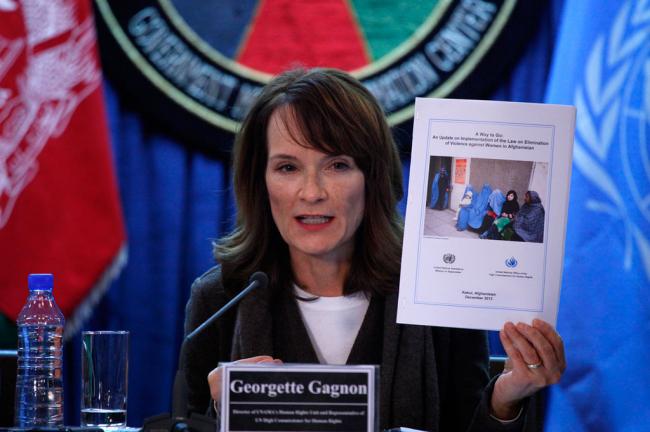
Afghanistan: Outgoing official at UN pledges commitment to advancing women’s rights
Georgette Gagnon, Human Rights Director of the UN Mission to Afghanistan (UNAMA), alsosaid in an interview released today, that while UNAMA’s work did result in government and international forces adopting procedures to limit their actions’ impact on civilians, the figures of civilians killed or injured is higher in 2015 than at any previous recorded stage in the conflict.
Speaking after completing more than five years as senior UN human rights official in Afghanistan, she said “civil society in Afghanistan is vibrant; it is very human-rights based and human-rights friendly, and it is taking forward the human rights struggle here.”
“That, of course, is very encouraging,” Gannon said.
But Gagnon referred to the case of Farkhunda, the Afghan woman who was brutally murdered by a Kabul mob on 19 March and whose death prompted calls within and outside Afghanistan for authorities to protect women’s rights.
“Many women’s groups and others went on the street to demonstrate for proper, prompt justice,” she said.
She added, “Unfortunately, there has not been proper, prompt justice.”
“There still are many serious issues with women’s rights,” she said.
She added, “The level of violence against women is still high; the government does need to do much more to address it.”
In the interview, Gagnon said highlighted positive and encouraging indicators against a backdrop of enormous challenges posed by conflict, as well as by the complex political and economic situation.
“We’re expecting that the gains made will be sustained, will not be rolled back, and will not be sacrificed,” she said.
She noted that civil society groups, in particular, are advancing the human rights struggle in Afghanistan.
Gagnon also spoke about critical issues for Afghanistan, such as civilian protection during armed conflict, children in conflict, women’s issues, detention practices and peace and reconciliation initiatives.
On protection of civilians, she said that, during the last five years, UNAMA had dedicated resources to meticulously documenting the impact of the conflict on civilians across the country to get the parties to the conflict to take concrete steps to mitigate the effects on civilians – to protect lives.
Gagnon described how the United Nations continues working with all parties to abide with their national and international obligations to protect civilians.
“We’re bringing forward our findings, our documentation, our reporting, and we’re urging and putting forward recommendations, practical ways and means to reduce civilian casualties,” she said.
She added, “We have regular dialogue in the field with the military actors, urging them to abide by their obligations to protect civilians – ensure they have directives in place, rules of procedure, rules of engagement that put the protection of civilians at the centre.”
Photo: Fardin Waezi/UNAMA
Support Our Journalism
We cannot do without you.. your contribution supports unbiased journalism
IBNS is not driven by any ism- not wokeism, not racism, not skewed secularism, not hyper right-wing or left liberal ideals, nor by any hardline religious beliefs or hyper nationalism. We want to serve you good old objective news, as they are. We do not judge or preach. We let people decide for themselves. We only try to present factual and well-sourced news.
Support objective journalism for a small contribution.


