U.K. & India share experience on 'When Criminal Justice Goes Wrong'
The criminal justice system is one of the frameworks through which the life and liberty of a person can be curtailed. The system depends on various players – from the police, to courts, to witnesses, to be able to effectively adjudicate, and to uphold the rule of law. However, the criminal justice system often goes wrong. When it does, it adversely impacts the rights of a person – be it an accused person, a victim of crime, or a witness.
Article 3 of the Universal Declaration of Human Rights states that: “Everyone has the right to life, liberty and security of person.” Constitutions of most countries also recognize this basic human right. The workshop also aimed on learning from each other’s experiences and research methods, the objective is to discuss possible collaborations in research on the theme of “when criminal justice goes wrong.”
At the inauguration of seminar Justice A.K Sikri, Judge, Supreme Court of India & former Chancellor, NLU, Delhi emphasised the need for a humane and sensitive criminal justice system. He narrated several decided cases to demonstrate the fact that due to the under performsnce, lawyers and prosecution the accused and the victim have to face lots of disadvantages. He stressed that there is need to modernise the legal system.
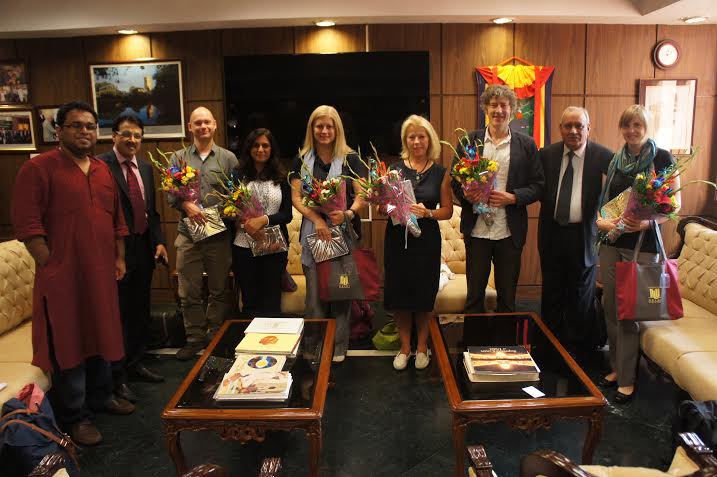
Prof. (Dr.) Ranbir Singh, Vice-Chancellor, NLU, Delhi highlighted the research forum of NLU Delhi mentioned about the role of significant research being conducted in the university on the subject like Death penalty, E Court, impact of Act Juvenile Justice Act and legal aid programs for prisoners etc and he also expressed the possibility of Oxford delegation entering in to useful joint collaborations with the university.
Prof. Carolyn Hoyle, Professor of Criminology and Director of the Centre for Criminology, University of Oxford, also expressed satisfaction that NLUD has tremendous potential to change the landscape of legal education in India.
Prof. (Dr.) G.S. Bajpai Registrar, NLU, Delhi informed that the two partners have already discussed the possible area of mutual collaboration for joint research and academic exchange program.
They also discussed the interface of victims and witnesses with the criminal justice system, and how arbitrariness leads to the violation of the rule of law. The discussants will not only respond to the issues raised by the presenters, but also focus on critical issues such as access to justice, pre-trial detention (including bail) and other experiences within the Indian criminal justice system. It is hoped that these discussions will not only lead to development of ideas and strategies to ensure that the rights of all the parties in the system are upheld, and errors in the criminal justice system are minimized. Research collaborations on studying and analysing this important issue will also be explored. Those involved in the workshop from Oxford include Prof Ian Loader, Prof Rachel, Prof Bredford, Dr Sarah.
Support Our Journalism
We cannot do without you.. your contribution supports unbiased journalism
IBNS is not driven by any ism- not wokeism, not racism, not skewed secularism, not hyper right-wing or left liberal ideals, nor by any hardline religious beliefs or hyper nationalism. We want to serve you good old objective news, as they are. We do not judge or preach. We let people decide for themselves. We only try to present factual and well-sourced news.
Support objective journalism for a small contribution.