 Khalistan
The Khalistan Conundrum: Where does history truly point?
The very name ‘Punjab’ evokes vivid memories, from the verdant fields of wheat swaying with the breeze to the valorous tales of its inhabitants. Punjab, or the land of the five rivers, is a region that has seen many rulers, and among them, the Sikh Empire stands out prominently. At its zenith, the empire was ruled from Lahore, a city that today sits in Pakistan.
Post-Partition, it’s undeniable that a significant part of Punjab, including Lahore, went to Pakistan. Historically, the Sikh Empire, with its legendary ruler Maharaja Ranjit Singh, had Lahore as its capital. This alone can evoke sentimentality for Sikhs who look upon Lahore with both pride and nostalgia.
Yet, the narrative around Khalistan is predominantly centered around the Indian Punjab. A question arises: If Khalistan is rooted in historical geography, shouldn’t its focus be on Pakistan, which housed a more significant part of the erstwhile Sikh Empire?
Furthermore, Pakistan is home to many revered Sikh religious sites. The Gurdwara Nankana Sahib, the birthplace of Guru Nanak Dev Ji is not just a religious site; it’s the cradle of Sikh history and faith. Gurdwara Darbar Sahib in Kartarpur is where Guru Nanak Dev Ji spent his last days. Gurdwara Panja Sahib in Hasan Abdal, with its sacred rock bearing the handprint of Guru Nanak Dev Ji, is another significant pilgrimage site. These are not mere structures of brick and mortar but are foundational stones of Sikhism and its rich history.
Despite such profound Sikh landmarks in Pakistan, the clamor for Khalistan is curiously limited to Indian Punjab. Enter the Inter-Services Intelligence (ISI) of Pakistan. Allegations have often surfaced, citing the ISI’s involvement in fuelling and funding Khalistani extremism. If the aim were solely to carve out a Sikh homeland based on historical and religious significance, one would wonder why the demand does not cover the historically rich areas of Punjab in Pakistan.
Over the years, Pakistan, despite its significant Sikh historical legacy, has been a challenging place for its Sikh minority. Sikhs, who once had a vibrant presence in the region, particularly in areas that formed the core of the Sikh Empire, have faced persecution and marginalization. Discriminatory policies, social ostracization, and instances of violence have diminished their numbers and silenced many voices. It’s a somber reflection of these circumstances that today, only about 15,000 Sikhs remain in Pakistan, a stark contrast to their once flourishing community.
The shadow of the ISI raises uncomfortable questions: Is the Khalistan movement genuine, or is it being manipulated as a tool to create unrest in India? The very idea of using religion and regionalism as pawns in a geopolitical chess game is both treacherous and against the very ethos of Sikhism.
This brings us to the core of Sikh teachings. Sikhism, as laid down by the ten Gurus, has always preached values of unity, peace, and selfless service. The violence and unrest seen in the name of Khalistan are antithetical to these principles. The idea of Sikhs, known for their valor, kindness, and community service, being manipulated for political gains is disheartening.
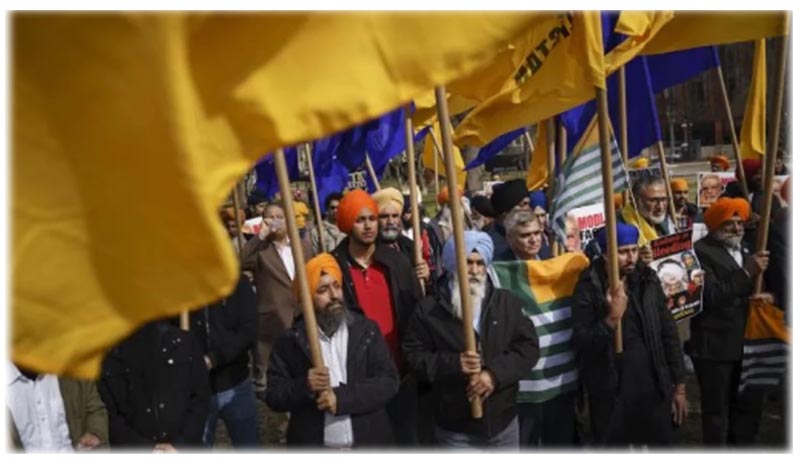
It’s also imperative to note that the vast majority of Sikhs, both in India and globally, do not demand Khalistan. The voices advocating for it are but a vocal minority, and one might speculate that they’re driven by personal or external vested interests rather than the collective good of the Sikh community.
While the historical and religious roots of Sikhism in both Indian and Pakistani Punjab are undeniable, the Khalistan movement, as it stands today, appears to be a deviation from Sikh values and history. Using this as a wedge to create unrest seems more political than pious, and it’s high time this issue is viewed through the lens of history, values, and genuine aspirations of the Sikh community.
(Image and text credit: Khalsavox.com)
Support Our Journalism
We cannot do without you.. your contribution supports unbiased journalism
IBNS is not driven by any ism- not wokeism, not racism, not skewed secularism, not hyper right-wing or left liberal ideals, nor by any hardline religious beliefs or hyper nationalism. We want to serve you good old objective news, as they are. We do not judge or preach. We let people decide for themselves. We only try to present factual and well-sourced news.
Support objective journalism for a small contribution.