 Sam Pitroda
Telecommunication has gone beyond our imagination to build the new world: Sam Pitroda
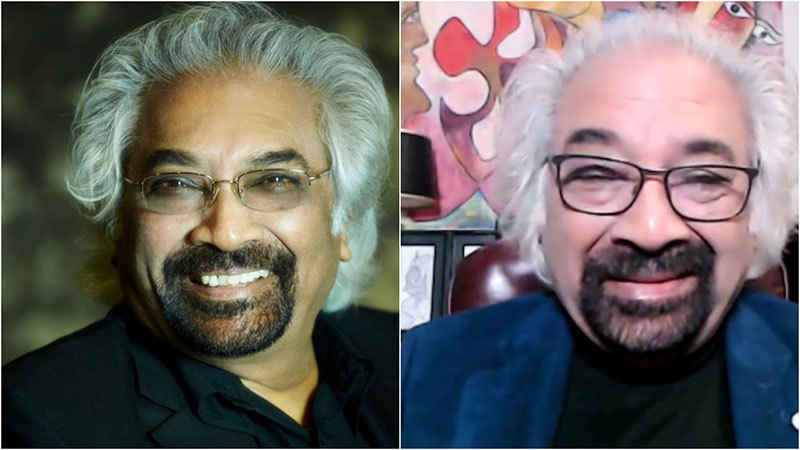
India's computer and IT revolutioner, former advisor to Prime Ministers late Rajiv Gandhi and Dr. Manmohan Singh, Sam Pitroda, was the guest at Ek Mulakat Vishesh organised by Prabha Khaitan Foundation (PKF) and Shree Cement. In a conversation with Ehsaas Woman of Delhi Archana Dalmia, Pitroda, who is also associated with India's oldest political party Congress, spoke about his life, technology and more. IBNS correspondent Souvik Ghosh brings highlights of the conversation
Tell us about your childhood and growing up years.
My journey started in a small, little tribal village in Odisha in 1942. My parents came from Gujarat looking for work in Odisha. My role models growing up were Mahatma Gandhi, Pandit Nehru, Sardar Patel, Maulana Azad, Subhas Chandra Bose, Rabindranath Tagore, Sarojini Naidu. Being a Gujarati, we had a special emotional connection with Gandhiji.
I was sent to a boarding school at the age of nine with my brother. In the boarding school, we had reinforced the Gandhian values. After five years, I moved to Baroda to go to my engineering school and did my masters in Physics.
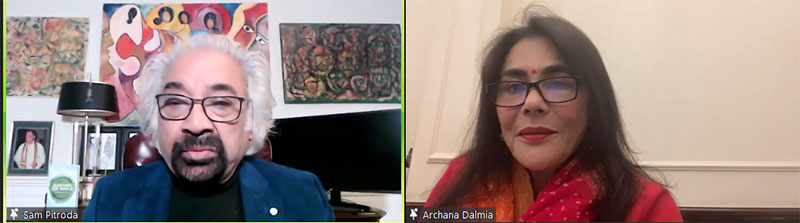
In your recently published book 'Redesign the World - A Global Call to Action', you talked about the historical opportunities post COVID-19 to rethink the world with an emphasis on science and technology. How do you think these ideas towards human development can be implemented in India?
While I was self-quarantined for 18 months during COVID-19 phase, I had decided to write the book. Through my analysis, I found the world was last designed just about the time when I was born. Then US-led design during World War II gave birth to the UN, World Bank, IMF, NATO, WTO, WHO, GDP etc..
The redesigning of the world can be done by beginning a new conversation, exciting young people whose future is at stake, sensitising, identifying the change agents, bringing about generational changes through new conversation. Somebody has to dream. People should be sensitised and seeds should be planted to redesign the world.
Do you think the new telecommunications technology can help in disaster management?
Absolutely. India is a nation of connected billions. For the first time in human history, we are all connected. Borders do not have the same meaning we had before hyper-connectivity. Borders, nationality mean something else now. In the present time, one can have loyalty to multiple countries, values, ethics, morals, human rights, democracy and it's wrong to say that one belongs to only one country. I think IT and telecom have changed the face of India.
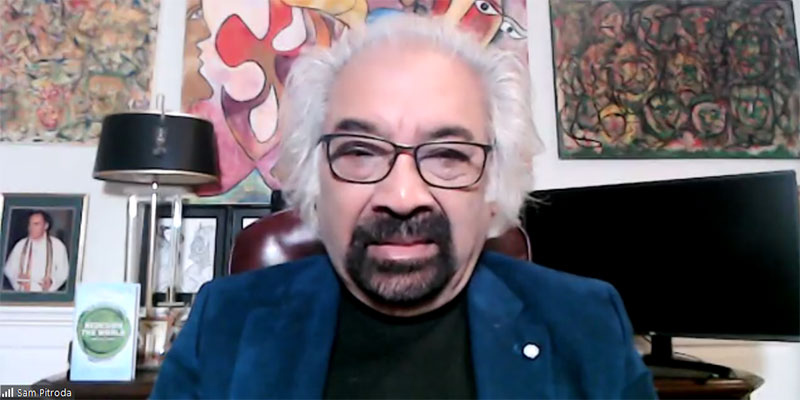
We have seen the benefit of IT during COVID-19 crisis. We could connect to loved ones and get information on them and all that at zero cost. It's a great contribution of hyper-connectivity which is about the democratisation of information, decentralisation of implementation and demonetisation of services. It is about both content and context. To me, hyperconnectivity is more like fire.
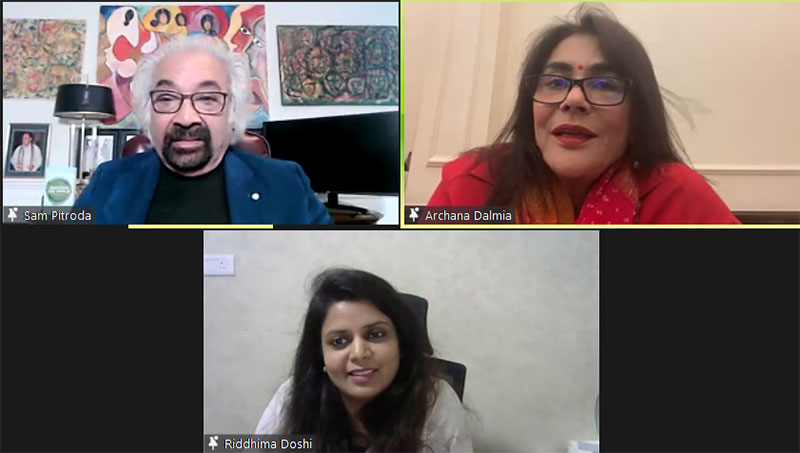
Has telecommunication become the way you had envisioned?
I think so. I think telecommunication has gone beyond our imagination. None of us with all our expertise had ever dreamed of the internet the way it has evolved. So we are all equally and pleasantly surprised by the prominent role taken by the telecom in building the new world.
With the growing space of the IT industry, do you think we can bridge the gap between demand and supply?
I think so. The point is we also need to look at demand differently. We cannot look at demands like the way the world looks at. We must realise that consumption has its limitations. The whole idea of consumption has to change. So demand as we see now is very different. It is the demand of the people who can afford to buy and not by people who need it. People need a simple life, as Gandhiji taught us, and we need to tone down things. The capability of affording a thing doesn't mean one should have it. People need to live a modest life.

Support Our Journalism
We cannot do without you.. your contribution supports unbiased journalism
IBNS is not driven by any ism- not wokeism, not racism, not skewed secularism, not hyper right-wing or left liberal ideals, nor by any hardline religious beliefs or hyper nationalism. We want to serve you good old objective news, as they are. We do not judge or preach. We let people decide for themselves. We only try to present factual and well-sourced news.
Support objective journalism for a small contribution.