Rajnath Singh calls for collective international action to counter terrorism
New Delhi, Sept 6 (IBNS): Indian Defence Minister Rajnath Singh has called for a collective international action to check perpetrators of terrorism and advocated strong measures against those who support and finance terrorism and provide sanctuary to terrorists.
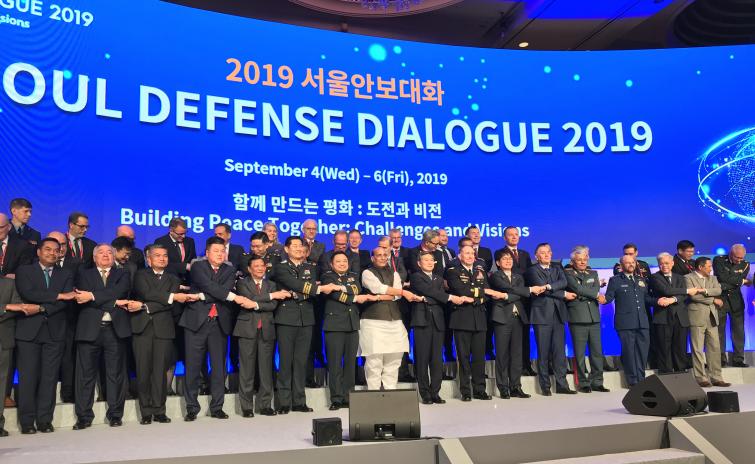
Delivering a keynote address at the ‘Seoul Defence Dialogue 2019’ with the theme, ‘Building Peace Together: Challenges and Vision’, during his visit to Republic of Korea (ROK), Rajnath Singh said “of the numerous security challenges that the world is facing, the gravest is that of terrorism.”
"No country in the world is safe from terrorism and India has been actively pursuing counter terrorism cooperation bilaterally, regionally and globally through UN and other fora," he added.
Rajnath Singh said, world politics today is in a state of flux and this has aggravated global and regional challenges to international peace and security.
He added that new and emerging technologies have impacted the regional as well as global security environment.
“Our region is confronted with numerous traditional and non-traditional security threats such as terrorism, conflicts, transnational crimes, maritime threats, proliferation as well as the challenges of sustainable development, including the lack of energy, low intra-regional trade and lack of connectivity,” he said.
Singh emphasised that good relations with neighbours – both immediate and extended – are a priority for India’s foreign policy as part of its Neighbourhood First Policy.
“A key feature of India’s Neighbourhood First Policy is also its engagement with its neighbours in sub-regional groupings of Indian Ocean Rim Association (IORA) and Bay of Bengal initiative for Multi-Sectoral Technical and Economic Cooperation (BIMSTEC), apart from a trilateral maritime co-operation format with Sri Lanka and Maldives to improve Maritime Domain Awareness and co-operation,” he added.
Rajnath Singh expressed India’s support for peace and stability in the Korean Peninsula and its denuclearisation through dialogue and diplomacy.
“Our quest for common prosperity and security requires us to evolve a common rules-based order for our region, the Indo-Pacific region. This order must be based on sovereignty and territorial integrity and equality of all nations, irrespective of size and strength. These rules and norms must be based on the consent of all,” he said.
Singh said India has strengthened co-operative engagements in the Indo-Pacific region on the basis of the principle of “SAGAR – Security and Growth for All in the Region”, a principle that remains the cornerstone of India’s outlook for the Indo-Pacific region.
He advocated for an open and inclusive architecture for the Indo-Pacific region with Association of Southeast Asian Nations (ASEAN) centrality, equal access to the global commons, freedom of navigation in the seas and in the air and unimpeded commerce, the importance of connectivity, a rules-based order and dialogue as the means to resolve disputes.
Rajnath Singh said Asia can make 21st century as century of peace and holistic development, where the nations can tackle the common challenges of poverty, disease, illiteracy and terrorism.
He stressed the five principles of Indian thought –Samman (respect), Samvad (dialogue), Sahayog (cooperation), Shanti (peace) and Samriddhi (prosperity) - to achieve this goal.
Raksha Mantri said India and ROK play a stellar role in bringing about peace, progress, prosperity, riding on twin pillars of economic and security partnership.
Support Our Journalism
We cannot do without you.. your contribution supports unbiased journalism
IBNS is not driven by any ism- not wokeism, not racism, not skewed secularism, not hyper right-wing or left liberal ideals, nor by any hardline religious beliefs or hyper nationalism. We want to serve you good old objective news, as they are. We do not judge or preach. We let people decide for themselves. We only try to present factual and well-sourced news.
Support objective journalism for a small contribution.