 Semiconductor
India's massive semiconductor push: Narendra Modi unveils Kaynes plant in Gujarat
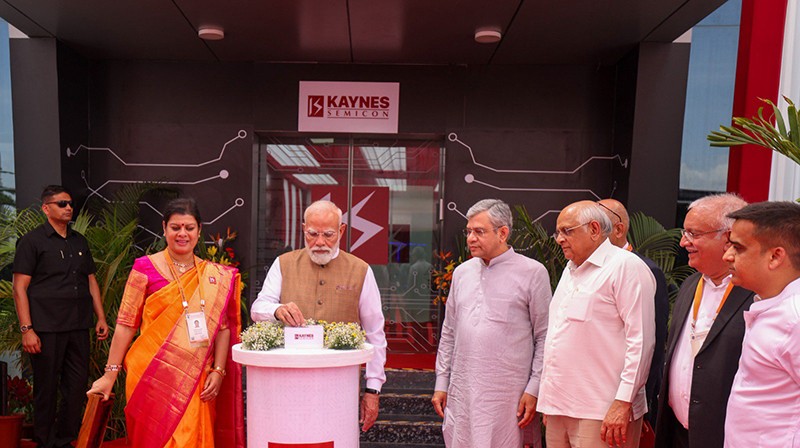
Indian Prime Minister Narendra Modi on Tuesday inaugurated the Rs 3,300 crore semiconductor plant by Kaynes Technology at Sanand, Gujarat.
"This is a wonderful beginning. In the coming days, many Indian companies, through global collaboration, will give the world a resilient semiconductor supply chain," he said.
With the facility supplying Intelligent Power Modules to a California-based company and a large share of its output already booked for export, he noted that a new bridge has effectively been built between Sanand and Silicon Valley.
"The modules made in Sanand will reach American companies and from there will power the entire world," said Modi.
Self-reliance in semiconductors
Explaining that self-reliance in semiconductors cascades into self-reliance across AI, electric vehicles, clean energy, defence, and electronics, PM Modi affirmed, "This mission is not just an industrial policy, it is a declaration of India's self-confidence".
India’s semiconductor industry is thriving across different states, generating new opportunities for countless youngsters. We are now working on Semiconductor Mission 2.0 to add further scale to these efforts. pic.twitter.com/O900MQga19
— Narendra Modi (@narendramodi) March 31, 2026
Detailing the progress of the mission, the Prime Minister noted that work is underway on 10 projects worth over Rs. 1,60,000 crore across six states, with the Kaynes and Micron projects being integral components.
He also highlighted the development of the indigenous Dhruv 64 microprocessor, which provides a secure processor platform for 5G infrastructure, automotive electronics, and industrial automation.
"India is building the capacity to design and manufacture at every level of the semiconductor value chain," Modi said.
India-Semiconductor Mission 2.0
Announcing the next phase of India's semiconductor ambition, the Prime Minister spoke about the India-Semiconductor Mission 2.0, unveiled in this year's Union Budget.
With a focus on domestic production of semiconductor equipment and materials, the new phase aims to build a full-stack Indian semiconductor ecosystem.
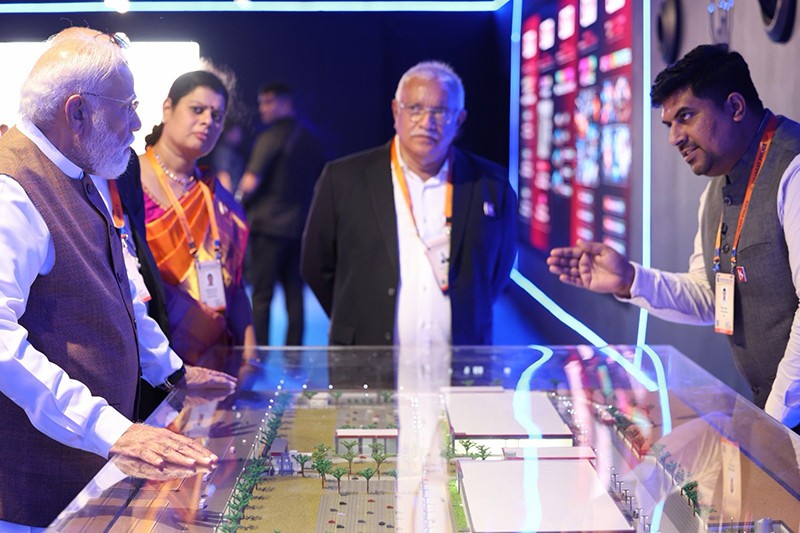
"Our effort now is to create an ecosystem so that we can forge big partnerships in both domestic and global supply chains," said PM Modi.
Training 85,000 design professionals
The Prime Minister highlighted India's efforts to build a future-ready workforce, noting that the target of training over 85,000 design professionals will be achieved very soon.
He also spoke about the Chips to Startup programme, under which nearly 400 universities and startups have been given access to modern design tools, resulting in the design and manufacture of over 55 chips.
"Technology development and a skilled workforce must go hand in hand , India is ensuring both," said Modi.
India's semiconductor market
It is indeed a proud moment for India’s Semiconductor ecosystem that the Kaynes Semicon OSAT facility has been inaugurated in Sanand, Gujarat. This will boost India’s efforts of emerging as a leader in futuristic technologies and innovation. pic.twitter.com/Soz8BXPWaa
— Narendra Modi (@narendramodi) March 31, 2026
Citing industry estimates, the Prime Minister noted that India's semiconductor market currently stands at approximately $50 billion and is projected to cross $100 billion by the end of this decade.
Observing the immense enthusiasm among global investors for India's semiconductor resolve, PM Modi remarked, "Our target is to manufacture the maximum number of chips for our needs right here in India,"
The Prime Minister spoke about India's parallel efforts to secure a resilient raw material supply chain, including India's membership in Pax Silica and the launch of the National Critical Minerals Mission.
He highlighted the 1,500-crore scheme for mineral recycling and the announcement of a Rare Earth Corridor connecting coastal states like Odisha, Andhra Pradesh, Tamil Nadu, and Kerala.
Support Our Journalism
We cannot do without you.. your contribution supports unbiased journalism
IBNS is not driven by any ism- not wokeism, not racism, not skewed secularism, not hyper right-wing or left liberal ideals, nor by any hardline religious beliefs or hyper nationalism. We want to serve you good old objective news, as they are. We do not judge or preach. We let people decide for themselves. We only try to present factual and well-sourced news.
Support objective journalism for a small contribution.