 Student Protest
How Jharkhand students’ protest differs from CJP-led agitation at Delhi’s Jantar Mantar
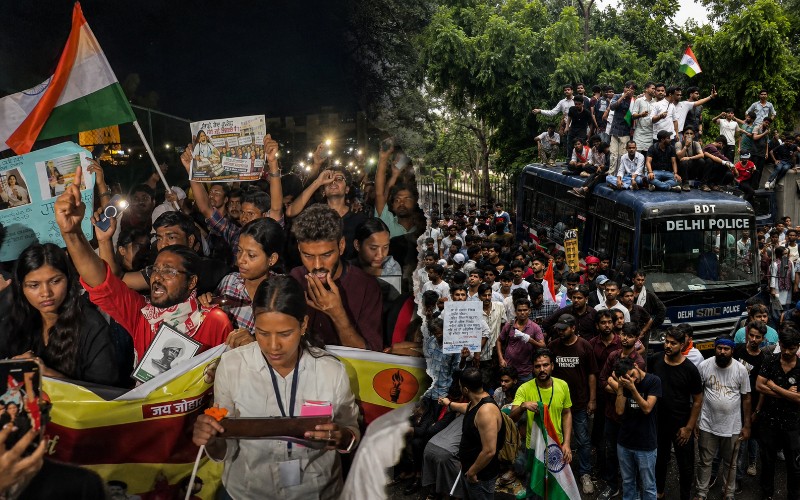
The protest landscape around competitive examinations has taken two distinctly different forms in recent weeks, with student demonstrations in Jharkhand’s Ranchi emerging on a markedly different footing from the agitation led by the Cockroach Janta Party (CJP) at Delhi’s Jantar Mantar.
While the CJP-led protest in Delhi centred on alleged irregularities in NEET and demands linked to the national medical entrance examination, the ongoing agitation in Ranchi involves job aspirants, many of them over 25, seeking an independent investigation into alleged irregularities in state-level recruitment examinations.
The Ranchi protesters, led by student leader Devendra Nath Mahto, have been staging a sit-in at Jaipal Singh Stadium since July 29.
Their demands centre on alleged malpractice in the 14th Jharkhand Public Service Commission (JPSC) Civil Services Examination, the Jharkhand Staff Selection Commission Combined Graduate Level (JSSC-CGL) examination and other recruitment tests.
The two protests share a broad concern over examination integrity, but differ significantly in their demands, the examinations involved, the profile of protesters and the nature of the alleged irregularities.
Why are Jharkhand students protesting?
The Ranchi agitation is primarily focused on alleged irregularities in government recruitment examinations in Jharkhand.
A large group of job aspirants has demanded the cancellation of the 14th JPSC Civil Services Examination and an independent investigation into alleged malpractice in the recruitment process.
The protesters have sought either a probe by the Central Bureau of Investigation (CBI) or an investigation by a panel of retired high court judges from outside Jharkhand.
According to the protesters, repeated allegations of examination malpractice are affecting the prospects of deserving candidates and undermining confidence in the state’s recruitment system.
They have alleged that examination seats were sold to candidates, including those from outside Jharkhand, for amounts ranging from Rs 50 lakh to Rs 1 crore.
These claims have been made by the protesters and would require investigation and verification by the competent authorities.
The students have also argued that repeated appeals to the government failed to result in concrete action, prompting them to intensify their agitation.
JPSC postpones Civil Services Mains exam
The agitation comes against the backdrop of the postponement of the JPSC Combined Civil Services Mains Examination.
The examination had originally been scheduled from July 25 to 27. JPSC subsequently postponed it, citing “unavoidable circumstances”.
The postponement has added to the concerns of candidates who have been demanding clarity over the recruitment process and an investigation into the alleged irregularities.
For the protesters, the issue goes beyond the postponement of one examination.
They have linked their demands to what they describe as a pattern of problems affecting competitive recruitment examinations in the state.
The demand for an independent investigation has consequently become one of the central features of the Ranchi protest.
How Ranchi protest differs Delhi agitation
Although both movements have involved students or examination aspirants and have raised concerns about the integrity of competitive examinations, their immediate triggers and demands are different.
The CJP-led protest at Delhi’s Jantar Mantar was linked to alleged irregularities in NEET, the national entrance examination for admission to medical colleges.
Protesters also demanded the resignation of Union Education Minister Dharmendra Pradhan.
NEET is primarily taken by students after completing their Class 12 examinations.
As a result, the Delhi protest included a significant number of younger participants, many of whom belonged to the Gen Z demographic.
The Ranchi protest, by contrast, is largely being led by older job aspirants preparing for government recruitment examinations.
Many of the participants in the Jharkhand agitation are aged above 25 and have spent years preparing for competitive examinations that can determine access to government employment.
This difference in the age and profile of protesters is one of the most visible distinctions between the two demonstrations.
The Jharkhand students’ protest is not “aesthetic” enough for big influencers and celebrities. That’s why they’re not supporting it.
— Gems (@gemsofbabus_) August 5, 2026
But WE WILL WIN! 🙏 pic.twitter.com/O8RhavCK6g
Different examinations, different stakes
The nature of the examinations involved also sets the two protests apart.
The Delhi agitation focused on NEET, an examination that determines access to undergraduate medical education and affects students seeking admission to medical colleges.
The Ranchi agitation is centred on recruitment examinations conducted for government jobs in Jharkhand.
For the protesters in Ranchi, the issue therefore directly concerns employment prospects and the recruitment process for government positions.
Candidates preparing for JPSC and JSSC examinations often spend several years preparing for competitive tests.
Allegations of malpractice can consequently have implications not only for individual examinations but also for candidates who have invested significant time and resources in preparation.
The protesters have argued that such allegations need to be investigated independently to restore confidence in the recruitment process.
What are Jharkhand students demanding?
The Ranchi protesters have cancelled the 14th JPSC Civil Services Examination, one of their principal demands.
They have also sought an independent probe into alleged irregularities in the examination and other recruitment tests.
Their preferred options include a CBI investigation or a probe by retired high court judges from outside the state.
The protesters have maintained that repeated examination-related controversies are damaging the prospects of deserving candidates and weakening public confidence in recruitment examinations.
They have also argued that their decision to intensify the agitation followed what they described as a lack of concrete action despite repeated appeals to the state government.
The focus of their demands has therefore remained on examination transparency, accountability and the integrity of the government recruitment system.
Hemant Soren offers talks with protesters
Jharkhand Chief Minister Hemant Soren has responded to the agitation by offering talks with the protesting students.
In a post on X on Wednesday, Soren said issues relating to question paper leaks were a national problem and that his government was treating the concerns raised by the students with “utmost seriousness”.
माननीय विधानसभा में मीडिया बंधुओं से बातचीत...
— Hemant Soren (@HemantSorenJMM) August 5, 2026
मेरे युवा साथियों की चिंताएँ हमारे लिए अत्यंत गंभीर विषय हैं। पेपर लीक का विषय केवल झारखंड का नहीं है, बल्कि देश के अनेक राज्यों के युवाओं के सामने यह एक बड़ी राष्ट्रीय समस्या बन चुका है।
हमारी सरकार इस मामले पर पूरी गंभीरता के साथ… pic.twitter.com/AGRsy4sVJy
The Chief Minister said investigative agencies were working continuously and that those found responsible for alleged irregularities were being sent to jail.
“Our objective is not just to investigate but to provide a permanent solution to students’ concerns,” Soren said.
He added that the doors of the state government remained open for students to put forward their demands and suggestions.
Soren also said that every issue raised by the protesters would be examined carefully and that a concrete solution would be announced soon.
The government’s response has thus focused on dialogue as well as investigation into alleged examination irregularities.
Officials invite student delegation for talks
Efforts to initiate direct discussions with the protesters have also begun at the local administrative level.
Ranchi Sub-Divisional Officer Kumar Rajat and Additional District Magistrate (Law and Order) Dhananjay Kumar visited the protest site.
The officials invited a five-member delegation of students for discussions at the Chief Minister’s residence.
The proposed meeting provides a channel for the protesting students to put their demands directly before the state government while officials assess the issues raised during the agitation.
The development comes as the students continue to press for an independent investigation and cancellation of the 14th JPSC Civil Services Examination.
Support Our Journalism
We cannot do without you.. your contribution supports unbiased journalism
IBNS is not driven by any ism- not wokeism, not racism, not skewed secularism, not hyper right-wing or left liberal ideals, nor by any hardline religious beliefs or hyper nationalism. We want to serve you good old objective news, as they are. We do not judge or preach. We let people decide for themselves. We only try to present factual and well-sourced news.
Support objective journalism for a small contribution.