 AI
AI
From AI to chips: Ashwini Vaishnaw unveils India’s big tech playbook at Davos
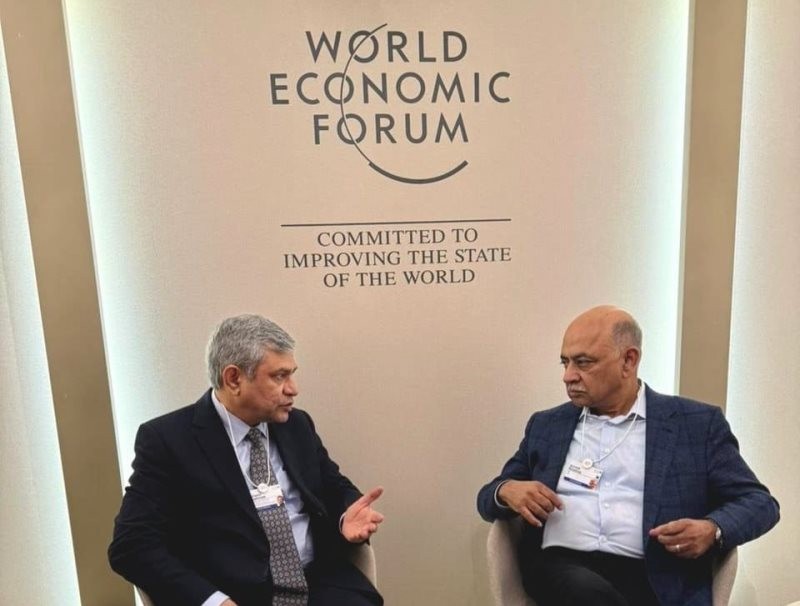
Union Minister for Electronics and Information Technology, Railways, and Information & Broadcasting, Ashwini Vaishnaw, outlined India’s ambitious and integrated strategy for artificial intelligence, semiconductors, and deep-tech innovation during multiple interactions on the sidelines of the World Economic Forum (WEF) Annual Meeting 2026 in Davos.
AI Impact Summit: Focus on Impact, Inclusion and Safety
Highlighting the vision behind the upcoming AI Impact Summit, Vaishnaw said the event has been designed with a sharp focus on outcomes rather than rhetoric.
The first objective of the Summit, he noted, is impact—leveraging AI models, applications, and the broader ecosystem to enhance efficiency, boost productivity, and generate a strong multiplier effect for economic growth.
The second objective is accessibility, especially for India and the Global South. Drawing parallels with India’s success in building UPI and Digital Public Infrastructure (DPI), the Minister said the world is now looking to India to replicate a similar scalable, affordable, and inclusive AI stack.
Vaishnaw emphasised the need to address concerns around AI through robust guardrails, guidelines, and safety frameworks, adding that India should also build its own AI regulatory and safety stack.
He added that the Summit will see participation from global leaders and top technology executives, alongside major investment announcements and the rollout of India’s indigenous AI models.
Startup Surge and Deep-Tech Push
The Minister highlighted that India now has nearly 200,000 startups, placing it among the top three startup ecosystems globally. Over the past decade, he said, there has been a decisive shift towards deep-tech innovation.
Notably, 24 Indian startups are currently designing semiconductor chips, one of the most complex and capital-intensive domains. Of these, 18 have already secured venture capital funding, reflecting strong investor confidence in India’s deep-tech potential.
India’s Semiconductor Roadmap
Detailing India’s semiconductor strategy, Vaishnaw pointed out that nearly 75 percent of global chip demand lies in the 28nm to 90nm range, catering to sectors such as electric vehicles, automobiles, railways, defence, telecom equipment, and consumer electronics.
India, he said, is prioritising mastery in this segment before moving to advanced nodes. In collaboration with industry partners, including IBM, India has a clearly defined roadmap—from 28nm to 7nm by 2030, and 3nm by 2032.
Expressing confidence in India’s trajectory, the Minister said the country is poised to become one of the top four or five semiconductor nations globally, backed by its vast talent pool, strong design capabilities, expanding manufacturing ecosystem, and a rapidly growing electronics market.
Key Global Tech Meetings at Davos
On the sidelines of WEF, Shri Vaishnaw met Google Cloud CEO Thomas Kurian, as Google reaffirmed its commitment to India’s AI ecosystem. This includes a $15 billion AI data centre in Vizag, Andhra Pradesh, and deeper partnerships with Indian startups.
He also met Joel Kaplan, Chief Global Affairs Officer, Meta, where discussions focused on protecting social media users from deepfakes and AI-generated content. Meta briefed the Minister on its ongoing efforts to strengthen platform safety and user protection.s.
Support Our Journalism
We cannot do without you.. your contribution supports unbiased journalism
IBNS is not driven by any ism- not wokeism, not racism, not skewed secularism, not hyper right-wing or left liberal ideals, nor by any hardline religious beliefs or hyper nationalism. We want to serve you good old objective news, as they are. We do not judge or preach. We let people decide for themselves. We only try to present factual and well-sourced news.
Support objective journalism for a small contribution.