 SJaishankar
Border peace basis for normal ties with China: EAM Jaishankar
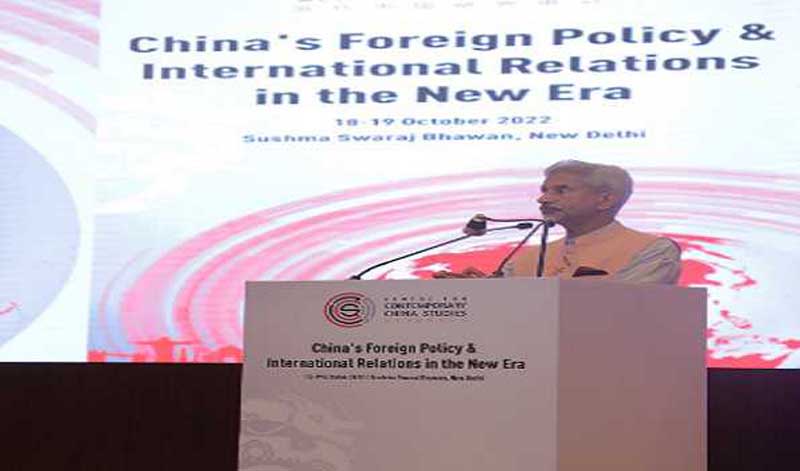
New Delhi: Peace and tranquility in the border areas remains the basis for normal relations between India and China, External Affairs Minister Dr S. Jaishankar said on Tuesday, adding that the continuing impasse in Eastern Ladakh will not benefit either country.
He was delivered the keynote address at a conference of the Center for Contemporary China Studies (CCCS) on China's Foreign Policy and International Relations in the New Era.
"Peace and tranquility in the border areas clearly remains the basis for normal relations. From time to time, this has been mischievously conflated with the sorting out of the boundary question," he said.
Referring to the ongoing situation in Eastern Ladakh, Dr Jaishankar said the last few years have been a period of serious challenge, both for the relationship and for the prospects of the continent.
"The continuation of the current impasse will not benefit either India or China. New normals of posture will inevitably lead to new normals of responses," he added.
The Minister said the Indian policy in the past has exhibited a remarkable degree of self-restraint that led to the expectation that others can have a veto over its choices.
"That period, however, is now behind us. The new era is apparently not just for China," asserted Dr Jaishankar.
The Minister, referring to the Galwan Valley incident, said that establishing a modus vivendi between India and China after 2020 is not easy.
"Yet, it is a task that cannot be set aside. And this can only become sustainable on the basis of three mutuals -- mutual respect, mutual sensitivity and mutual interest," he said.
"It is the willingness to take a long-term view of their ties that the two countries must display today."
(With UNI inputs)
Support Our Journalism
We cannot do without you.. your contribution supports unbiased journalism
IBNS is not driven by any ism- not wokeism, not racism, not skewed secularism, not hyper right-wing or left liberal ideals, nor by any hardline religious beliefs or hyper nationalism. We want to serve you good old objective news, as they are. We do not judge or preach. We let people decide for themselves. We only try to present factual and well-sourced news.
Support objective journalism for a small contribution.