 Assembly Polls
Big poll battle ahead! Election Commission announces dates for Bengal, Tamil Nadu, Kerala, Assam and Puducherry
The Election Commission of India on Sunday announced the polling schedule for assembly elections in four states and the Union Territory of Puducherry. Voting will take place between April 9 and April 29, with the counting of votes scheduled for May 4.
The elections are widely being seen as a mid-term political test for Prime Minister Narendra Modi and the Bharatiya Janata Party after their recent electoral successes in Bihar and Delhi.
According to the schedule announced by Chief Election Commissioner Gyanesh Kumar, the states of Assam, Kerala and the Union Territory of Puducherry will vote in a single phase on April 9.
All 234 constituencies in Tamil Nadu will go to the polls on April 23 to elect a new legislative assembly.
West Bengal to vote in two phases
In politically charged West Bengal, voting will be held in two phases on April 23 and April 29. Of the state’s total 294 seats, 152 constituencies will vote in the first phase on April 23, while the remaining 142 will vote on April 29.
This marks a significant reduction from the eight-phase polling conducted during the 2021 assembly elections.
.jpg)
.jpg)
Explaining the decision, Chief Election Commissioner Gyanesh Kumar said during a press conference that reducing the number of phases was necessary.
“It was necessary to bring down the number of phases in West Bengal. The Commission had detailed discussions about it, and this decision has been taken keeping in mind the benefit of all stakeholders,” he said.
17.4 crore voters are expected to cast their votes across poll-bound regions
Overall, around 17.4 crore voters are expected to cast their ballots in the elections.
The Election Commission said nearly 25 lakh election officials and staff will manage the voting process across approximately 2.19 lakh polling stations in the states and the Union Territory.
.jpg)
“The Commission is committed to ensuring free, fair, transparent and peaceful elections,” Kumar said.
He added that the poll body would ensure that no eligible voter is excluded from the electoral rolls while also preventing ineligible names from being included.
With the announcement of the election schedule, the Model Code of Conduct has come into immediate effect. Political parties are now barred from announcing new schemes or making promises intended to influence voters, while the Election Commission will oversee the administrative machinery during the poll period.
Key political battles
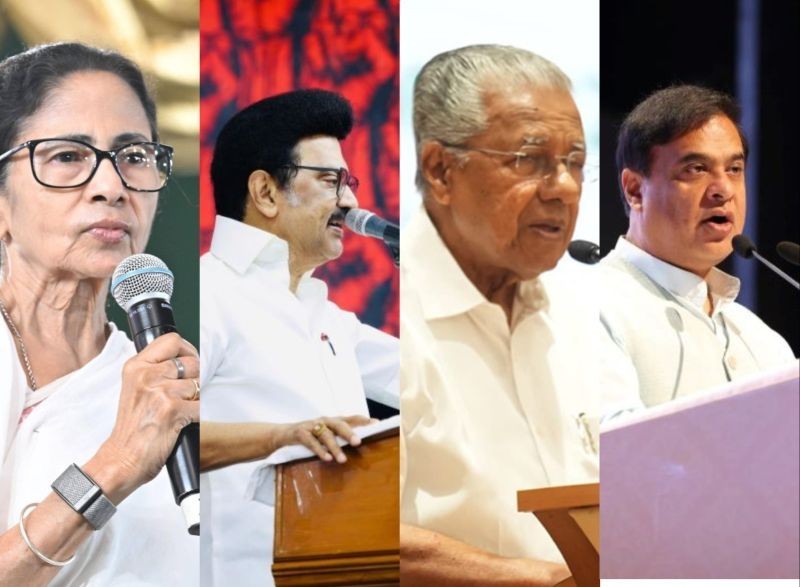
In West Bengal, Chief Minister Mamata Banerjee and her party, the All India Trinamool Congress, are aiming for a fourth consecutive term in power. The Bharatiya Janata Party is attempting to unseat the ruling party.
The elections come after the controversial Special Intensive Revision (SIR) of electoral rolls, which triggered strong political reactions in the state and also reached the Supreme Court of India.
The Trinamool Congress alleged that the exercise could lead to the deletion of genuine voters, particularly from minority and migrant communities. The BJP, however, supported the move, arguing that it would help remove illegal or duplicate entries from the voter rolls.
Petitions related to the voter list revision were later filed in the Supreme Court, with petitioners raising concerns about possible voter disenfranchisement. The Election Commission maintained that the process was being conducted strictly under election laws and verification procedures.
In Tamil Nadu, Chief Minister M. K. Stalin and the Dravida Munnetra Kazhagam are seeking a second term in office. The opposition alliance includes the All India Anna Dravida Munnetra Kazhagam and the Bharatiya Janata Party.
Actor-turned-politician Vijay has also entered the electoral fray with his party, the Tamilaga Vettri Kazhagam, adding a new dimension to the contest.
In Kerala, a traditional battle between the Left and the Congress is expected. Chief Minister Pinarayi Vijayan of the Communist Party of India (Marxist) is attempting to secure a third consecutive term, while the Indian National Congress hopes to capitalise on its performance in the 2024 Lok Sabha elections.
In Assam, Chief Minister Himanta Biswa Sarma of the Bharatiya Janata Party is seeking another term in office. The opposition challenge is led by Gaurav Gogoi of the Congress, though the party has faced setbacks, including the exit of former state president Bhupen Borah.
Meanwhile, in Puducherry, Chief Minister N. Rangasamy and his party, the All India NR Congress, are hoping to secure a third term, while the Dravida Munnetra Kazhagam is aiming to wrest power in the Union Territory.
Support Our Journalism
We cannot do without you.. your contribution supports unbiased journalism
IBNS is not driven by any ism- not wokeism, not racism, not skewed secularism, not hyper right-wing or left liberal ideals, nor by any hardline religious beliefs or hyper nationalism. We want to serve you good old objective news, as they are. We do not judge or preach. We let people decide for themselves. We only try to present factual and well-sourced news.
Support objective journalism for a small contribution.