 Rajnath Singh
4C formula building is key to tackling emerging peacekeeping challenges: Singh to Chiefs of UN troop contributing countries
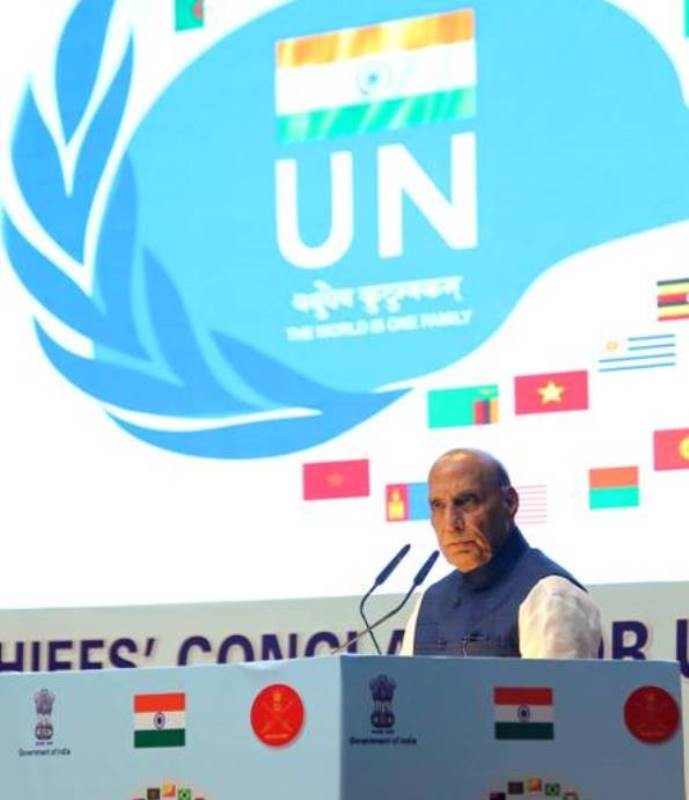
Indian Defence Minister Rajnath Singh has said an enhanced Consultation, Cooperation, Coordination & Capacity Building - a 4C formula - is a guiding principle for the countries contributing towards United Nations peacekeeping to tackle emerging challenges and ensure global peace.
He was addressing the senior military leadership of United Nations Troop Contributing Countries (UNTCC) during the inaugural session of the Chiefs’ Conclave, being hosted by India for the first time, at Manekshaw Centre, New Delhi from October 14-16, 2025.
Raksha Mantri highlighted the growing complexities of the challenges being faced by the peacekeepers today - from deployment in volatile environments where asymmetric warfare, terrorism, and fragile political settlements coexist to operating amid humanitarian crises, pandemics, or natural disasters, and confronting misinformation campaigns.
For the sustainability of peacekeeping operations, he urged the member states, especially those with advanced technological and financial capabilities, to enhance their support through troops, police, logistics, technology and specialised capacities.
He stressed that innovations such as secure communications, surveillance systems, and unmanned platforms can make missions safer & more effective.
“Meeting the emerging challenges demands, more than bravery, adaptability, innovation on part of the troop contributing countries and a comprehensive mission level approach taking onboard relevant political actors, finance contributing countries, and other key players influencing the conflict environment to achieve the mandate," Singh said.
"These operations often fall short due to delayed deployment, inadequate resources, and an insufficient mandate to address the root causes of conflicts. We cannot fight today’s challenges with outdated multilateral structures. Without comprehensive reforms, the UN faces a crisis of confidence. For today’s interconnected world, we need a reformed multilateralism: That reflects realities; Gives voice to all stakeholders; Addresses contemporary challenges; and focuses on human welfare,” said Rajnath Singh.
Singh pointed out that India has always stood firm with the UN in its mission to maintain international peace & security, and it remains steadfast in this commitment.
“Over the decades, nearly 2,90,000 Indian personnel have served in more than 50 UN peacekeeping missions, earning global respect for professionalism, courage, and compassion. From the Congo and Korea to South Sudan and Lebanon, our soldiers, police, and medical professionals have stood shoulder to shoulder with the international community to protect the vulnerable and rebuild societies. We are ready to contribute troops, share expertise, and support reforms that make peacekeeping more effective & accountable. Through cooperation and technology sharing, we can build missions that are better equipped, more adaptive & more humane,” he stated.
Adding that the success of peacekeeping depends not only on numbers but on preparedness, Rajnath Singh mentioned about the Centre for United Nations Peacekeeping in New Delhi which has trained participants from over 90 countries.
He pointed out that India has the necessary credentials to impart training and developing interoperability between peacekeepers from friendly countries to build the mutual understanding that is essential for mission success.
Singh added that under the Aatmanirbhar Bharat vision, India has developed cost-effective indigenous technologies which strengthen peacekeeping missions in the from of land mobility platforms, secure communications, surveillance systems, unmanned aerial vehicles and medical support solutions.
Rajnath Singh described the growing participation of women as one of the most inspiring transformations in peacekeeping, stating that their presence enhances the mission’s effectiveness, builds trust with local populations, and brings empathy into operations.
“India has been a pioneer in this domain. Our all-women Formed Police Unit deployed to Liberia in 2007 became a global symbol of empowerment. Their professionalism and compassion inspired a generation of Liberian women to join their national police. Today, Indian women officers serve in missions across South Sudan, Golan Heights and Lebanon, leading patrols, engaging with communities, and mentoring local women and youth. They represent the best of what modern peacekeeping can achieve — inclusion, respect, and trust. In 2024, an Indian Army woman peacekeeper was awarded the United Nations Military Gender Advocate of the Year Award for her exemplary service with the UN peacekeeping mission in the Democratic Republic of Congo,” he added.
On the participation of medical peacekeepers, Singh said Indian medical teams have treated thousands of civilians and peacekeepers in UN field hospitals across Africa.
“Their service, often under challenging adversities, embodies the finest traditions of the Indian peacekeepers and ethos of the UN in the spirit of humanity,” he said.
Rajnath Singh also underlined the fact that India’s aspiration to become a Vishwa Guru is not an assertion of dominance but a call for collaborative and inclusive progress.
He voiced India’s belief that by sharing its heritage of non-violence and inner peace, UN peacekeeping and peace-building operations can be enriched, fostering a world order where harmony prevails.
“Now-a-days, some nations are openly violating the international rules, some are trying to undermine it, while some want to create their own rules and dominate the next century. In all this, India, while advocating for the reformation of outdated international structures, stands strong in upholding the international rules-based order. India is land of Mahatma Gandhi, where peace is deeply rooted in our philosophy of non-violence and truth. For Mahatma Gandhi, peace was not merely the absence of war, but a positive state of justice, harmony, and moral strength,” added Singh.
Support Our Journalism
We cannot do without you.. your contribution supports unbiased journalism
IBNS is not driven by any ism- not wokeism, not racism, not skewed secularism, not hyper right-wing or left liberal ideals, nor by any hardline religious beliefs or hyper nationalism. We want to serve you good old objective news, as they are. We do not judge or preach. We let people decide for themselves. We only try to present factual and well-sourced news.
Support objective journalism for a small contribution.