Indigenous conductive ink manufacturing technology transferred to two startups in Punjab and Telangana
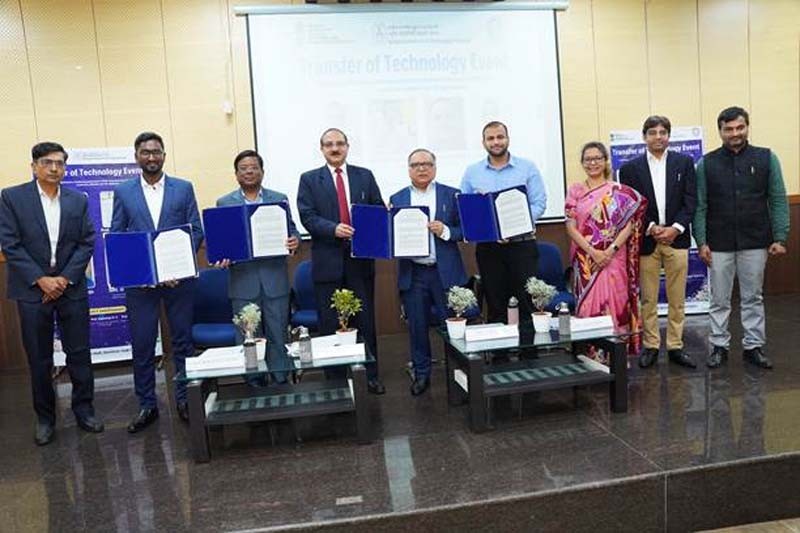
Warangal (Telangana): The indigenous know-how of silver nanowire-based conductive ink technology was transferred to two startups at a Friday event at NIT Warangal.
Chematico Technologies received the technology incubated at IIT Ropar and Vasanthbala Functional Materials received the technology incubated at NIT Warangal.
The global market for silver nanowire-based conductive ink and adhesive is projected to surpass $16.87 billion by 2032 due to a rapid increase in the electronics, semiconductor, solar photovoltaic, and RFID market.
The market growth can be attributed to key factors, including robust demand from end-use industries.
India imports ink worth around $15,72,000 every year.
The United States of America, the People's Republic of China, the Netherlands, the United Kingdom, and Taiwan are the major exporter countries.
The transferred technology has been developed under the project funded by the Ministry of Electronics and Information Technology (MeitY) and jointly implemented by Prof. Sarang Gumfekar, IIT Ropar and Prof. Shirish Sonawane, NIT Warangal.
Silver nanowire-based conductive ink is used commonly to repair or improve circuits on printed circuit boards.
The ink is used in flexible electronics (foldable devices/screens such as computer keyboards, windshield defroster), RFID tags, wearable devices, sensors, display technologies, solar panels, etc.
Speaking at the event, Unique Identification Authority of India (UIDAI) CEO Bhuvnesh Kumar Chief Guest, highlighted the transformative potential of developed indigenous nanosilver-based conductive ink technology in the field of semiconductor ecosystem having applications in flexible electronics, electronic packaging, displays, solar photovoltaics, RFID tags, etc.
While congratulating the startups, he suggested for the large-scale manufacturing of silver nanowires and the production of conductive ink in the country.
He added that the developed technology can reduce India’s conductive ink import for advanced electronic material applications.
Support Our Journalism
We cannot do without you.. your contribution supports unbiased journalism
IBNS is not driven by any ism- not wokeism, not racism, not skewed secularism, not hyper right-wing or left liberal ideals, nor by any hardline religious beliefs or hyper nationalism. We want to serve you good old objective news, as they are. We do not judge or preach. We let people decide for themselves. We only try to present factual and well-sourced news.
Support objective journalism for a small contribution.