September 21, 2026 11:15 pm (IST)

Follow us:


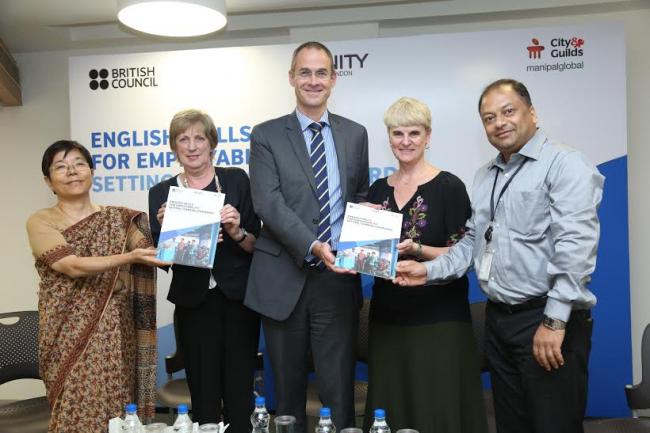
British Council launches report exploring role of English in NSQF
Kolkata, June 11 (IBNS): The British Council, in partnership with Manipal City and Guilds, Trinity College London and the National Skills Development Agency, have launched a report that explores the role of English in the NSQF, with a particular focus on English as a Skill for Employability for entry level and semi-skilled employment in the sectors of Healthcare, Hospitality and Construction.
The report also explores the facilitating role that the Common European Reference Framework (CEFR) for language can play for all languages in India, in the context of the NSQF, to improve the quality of language training and facilitate better progression in learning.
With two thirds of the region’s population below 30 years of age, employment and employability is a top developmental priority for countries in the region.
With two thirds of the region’s population below 30 years of age, employment and employability is a top developmental priority for countries in the region.
Many policy making bodies view English as a key skill and one that would go a long way in improving the opportunities and employability of the large and growing mass of youth in South Asia, in a fast globalising world.
In India, creating and formally adopting a national framework of occupational standards and qualifications through the National Skills Qualifications Framework (NSQF) is an important first step to improving employability skills, up-skilling Indian workers and ensuring that the quality of technical and vocational education and training (TVET) is standardised. This also ties in to the need for meaningful recognition of achievement of skills and knowledge, important for employment and progression (vertical or lateral) of workers and aspirants.
The research report ‘English Skills for Employability – Setting Common Standards’ is authored by Emma-Sue Prince, Director of Unimenta and S Manish Singh, Managing Director of PROGILENCE Capability Development Pvt. Ltd. The report was launched recently at the British Council in New Delhi.
Gill Caldicott Director Operations for India, British Council said, "Creating an entry level on the existing Common European Framework of Reference for Languages, or an Indian equivalent, would provide a great incentive for aspiring language learners, particularly adults in the workplace. The British Council looks forward to collaborating further with the National Skills Development Agency, Trinity College London and Manipal City & Guilds to identify priorities emerging from the research report and to agree how they can best be implemented."
John Yates, CEO, Manipal City & Guilds said, "Employability is a vital concept for India. It means a person’s ability to get a job, keep that job, and move on to their next job. Language and communication skills are a key foundation to employability. This important report recommends actions we can take collectively to build an India-specific framework for language and identifies a new entry level for English language skills that will be of great benefit to many industry sectors, employers and those looking for work."
Speaking on the occasion Sarah Deverall, Director Examinations Services for India, British Council said, “The proposed creation of a Common Indian Framework of Reference for Languages could enable standards to be set for language proficiency in English and Indian languages which could then be used by employers to benchmark language and communication skills and by training providers to design and deliver curricula and assessment bodies to develop assessment tools and approaches.”
In India, creating and formally adopting a national framework of occupational standards and qualifications through the National Skills Qualifications Framework (NSQF) is an important first step to improving employability skills, up-skilling Indian workers and ensuring that the quality of technical and vocational education and training (TVET) is standardised. This also ties in to the need for meaningful recognition of achievement of skills and knowledge, important for employment and progression (vertical or lateral) of workers and aspirants.
The research report ‘English Skills for Employability – Setting Common Standards’ is authored by Emma-Sue Prince, Director of Unimenta and S Manish Singh, Managing Director of PROGILENCE Capability Development Pvt. Ltd. The report was launched recently at the British Council in New Delhi.
Gill Caldicott Director Operations for India, British Council said, "Creating an entry level on the existing Common European Framework of Reference for Languages, or an Indian equivalent, would provide a great incentive for aspiring language learners, particularly adults in the workplace. The British Council looks forward to collaborating further with the National Skills Development Agency, Trinity College London and Manipal City & Guilds to identify priorities emerging from the research report and to agree how they can best be implemented."
John Yates, CEO, Manipal City & Guilds said, "Employability is a vital concept for India. It means a person’s ability to get a job, keep that job, and move on to their next job. Language and communication skills are a key foundation to employability. This important report recommends actions we can take collectively to build an India-specific framework for language and identifies a new entry level for English language skills that will be of great benefit to many industry sectors, employers and those looking for work."
Speaking on the occasion Sarah Deverall, Director Examinations Services for India, British Council said, “The proposed creation of a Common Indian Framework of Reference for Languages could enable standards to be set for language proficiency in English and Indian languages which could then be used by employers to benchmark language and communication skills and by training providers to design and deliver curricula and assessment bodies to develop assessment tools and approaches.”
Support Our Journalism
We cannot do without you.. your contribution supports unbiased journalism
IBNS is not driven by any ism- not wokeism, not racism, not skewed secularism, not hyper right-wing or left liberal ideals, nor by any hardline religious beliefs or hyper nationalism. We want to serve you good old objective news, as they are. We do not judge or preach. We let people decide for themselves. We only try to present factual and well-sourced news.
Support objective journalism for a small contribution.



Latest Headlines
Thiagarajar Polytechnic College receives Education Excellence Award for the fifth time
Mon, Sep 21 2026
Sona College of Tech, Salem team wins Mitsubishi contest for factory automation; beats 6 national winners across Asia
Fri, Sep 18 2026
No coaching, broken home, big dreams: How an Odisha family sent 5 children to medical college
Tue, Sep 15 2026
India’s deep-tech push goes global: 37 startups showcase innovation at BRICS Summit
Fri, Sep 11 2026
No industry skills after college? This government scheme offers paid apprenticeships and job opportunities
Fri, Sep 11 2026
IISWBM MSW Programme: Internships, Industry Exposure and Career Opportunities Explained
Sun, Sep 06 2026