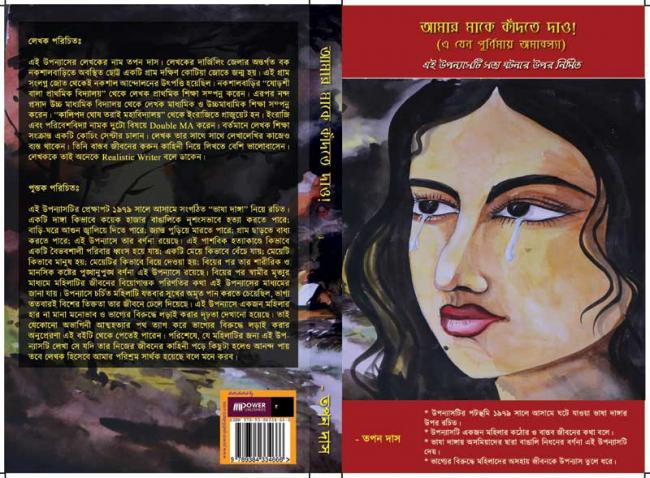
Book review: Amar ma ke kandte dao, a Bengali novel
“Amar ma ke kandte dao”, a Bengali novel written by Tapan Das, is about the life of an innocent girl, Tapashi, who loses everything after Assamese zealots ruthlessly attack her Bengali parents.
This story is actually based on true events and it presents a sad picture of the horrifying anti-Bengali movement that shook Assam.
Another theme that has been explored in this story is that the fates of some people are mired in misery and no matter how much they try, they never seem to run away from all the impending disasters.
This novel is set in the quaint little village of Mukundapur, in Assam. Tapashi is the only child of a rich village head, Radhanath. She was born to Radhanath and his wife after many years of their marriage.
She grows up to be a kind-hearted, sweet, and loving child, and soon becomes the apple of everyone’s eyes. It seemed as if little Tapashi was born with a silver spoon in her mouth.
Soon things begin to fall apart after her family is attacked by a few overzealous Assamese men due to some misplaced anger on Bengalis. Tapashi’s parents die in front of her eyes but her governess flees with her to safety.
But life has worse things in store for her yet because once someone loses his or her parents, then that loss becomes irredeemable.
Tapashi’s governess, her Sona Ma, turns out to be a greedy woman who starts using Tapashi’s property to raise her own children, and keeps Tapashi at home, without letting her get educated.
Tapashi is taught all kinds of household chores. In essence, she becomes a maid in her governess’ house.
The rest of the story follows Tapashi’s journey as she grows up and faces the various challenges that life throw at her.
This story throws light on the anti-Bengali movement that had swept through Assam during 1975-80.
Tapashi is a representative of the countless rural women who are exploited by their relatives and friends, who are deprived of all kinds of opportunities for self-growth.
The sad part is that such situations are still true and reading stories like these just make us realise that we all need to become more active in reaching out to such hapless women and help them find their footing.
The other characters who inhabit Tapashi’s world are also strongly reminiscent of people who we see in our daily lives.
Books like these just enhance the legacy of our rich literary world.
Reviewed by Priya Das
Support Our Journalism
We cannot do without you.. your contribution supports unbiased journalism
IBNS is not driven by any ism- not wokeism, not racism, not skewed secularism, not hyper right-wing or left liberal ideals, nor by any hardline religious beliefs or hyper nationalism. We want to serve you good old objective news, as they are. We do not judge or preach. We let people decide for themselves. We only try to present factual and well-sourced news.
Support objective journalism for a small contribution.