


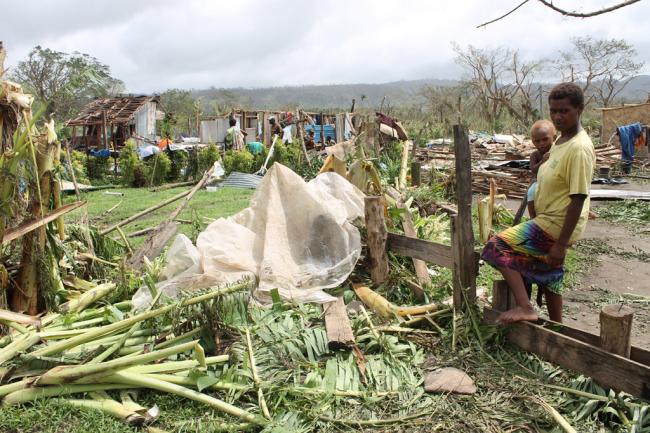
Vanuatu: UN finds 'extensive' loss of agriculture; full scale of damage still to be revealed
“Supporting Vanuatu after the disastrous cyclone begins with emergency agricultural assistance that FAO will provide together with the Government of Vanuatu and other partners,” said the agency’s Director-General José Graziano da Silva.
In a news release issued by the Rome-based agency, Graziano da Silva underlined FAO’s readiness and commitment to work closely together with the Government to “help rebuild people’s lives and livelihoods, particularly in the rural areas.”
An initial assessment has found “extensive damage” to crops, livestock and fisheries as a result of the storm, which battered the Pacific archipelago last weekend. The banana crop was almost entirely destroyed by the storm, as have most coconuts and all of the inland cabbage plants and leafy vegetables. Root crops, which are an important local food source, have been uprooted and flooded in most areas, while the majority of fruit trees have been stripped and chickens and pigs have been killed.
As well as crops, most household food and seed stocks and garden production were also destroyed, leaving many families without food and income and increasing the need for imports. With the first harvest from replanted fast-growing food crops likely to be available only in mid-June, Vanuatu could be without locally produced food until then.
The cyclone hit Vanuatu at the same time as a high-level UN meeting on disaster risk reduction was taking place in Japan. In a report published at the meeting, the FAO said that agriculture bears the brunt of natural disasters, citing $70 billion in damages – some 22 per cent of the total – to the agriculture sector inflicted by natural hazards.
It will be some time before the full scale of damages and needs on Vanuatu’s more than 80 islands will be known due to a lack of functional communications and limited access following the destruction, says FAO. However, with 99 per cent of all households on the outer islands dependent on agriculture for consumption needs and income, and with 75 per cent of households in the capital, Port Vila consuming their own produce, the impact will be large.
“This underlines the fundamental importance of agriculture and fisheries to the livelihoods of communities and the impact Pam will have on the food security of the affected population,” said Gavin Wall, FAO Sub-Regional Coordinator for the Pacific. “We know that Vanuatu communities have long-standing traditional coping mechanisms to address immediate food needs and resume their agricultural production. FAO must ensure its interventions support their work and address the long-term rehabilitation of the agriculture sector.”
In the immediate term, international assistance is needed for seeds, farming equipment and technical expertise and the Government has asked for support from FAO to help the agriculture sector get back on its feet. At the same time, the Department of Agriculture and Rural Development is urging farmers to use still available materials to begin replanting immediately to ensure food security for future months.
They will need to act quickly, urgently planting the more perishable materials like kumala vines and banana suckers, while simultaneously preserving or storing any available foods using traditional or modern methods like drying, salting, slow cooking meat, and burying root crops in the sand.
Photo: UNICEF/Gaelle Sevenier
Support Our Journalism
We cannot do without you.. your contribution supports unbiased journalism
IBNS is not driven by any ism- not wokeism, not racism, not skewed secularism, not hyper right-wing or left liberal ideals, nor by any hardline religious beliefs or hyper nationalism. We want to serve you good old objective news, as they are. We do not judge or preach. We let people decide for themselves. We only try to present factual and well-sourced news.
Support objective journalism for a small contribution.


