


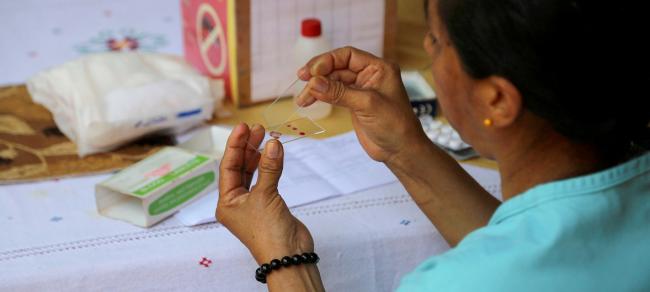
Uzbekistan wins its long fight against malaria, as global rates continue to rise
New York, Dec 12 (IBNS): Uzbekistan’s success in becoming recognized as a malaria-free country by the World Health Organization (WHO), is an “extraordinary outcome,” said the Executive Director of the Global Fund on Tuesday, a UN-backed partnership to end malaria epidemics.
Malaria has a long and deadly history in Uzbekistan: in the late nineteenth century, the disease killed nearly 40,000 people in the capital district alone, and in 1943, one tenth of the population was infected. In the post-war years, the Uzbek Government concentrated on eliminating malaria, but the country was hit by a devastating resurgence in the early 1960s.
That trend has been reversed in recent years, with the Global Fund and WHO helping Uzbekistan to combat malaria, using an innovative results-based approach that put the country on the path to finally eliminating the disease in 2018.
“We have achieved remarkable progress against malaria in Central Asia,” said the head of the Global Fund, Peter Sands. “It’s a great example of commitment and a sustainable approach. The Global Fund has invested in this region for over a decade. With committed partners, every investment can achieve great value.”
A significant number of countries are now eliminating malaria: in Central Asia – aside from Uzbekistan – Turkmenistan, Armenia and Kyrgyzstan have been classed as malaria-free since 2010.
However, these positive indicators are set against a worrying backdrop of increased global rates of infection: the WHO’s 2018 World malaria report, released in November, showed that targets to reduce new cases of infection worldwide (which call for a drop in malaria case incidence and death rates of at least 40 per cent by 2020) are not being met, and that, while new cases fell steadily up until 2016, the number rose from 217 million to 219 million in 2017.
“A child dies of malaria every two minutes,” said Sands. “We have to stop that, enabling elimination where possible, and reducing malaria as much as we can in the hardest-hit countries.”
Support Our Journalism
We cannot do without you.. your contribution supports unbiased journalism
IBNS is not driven by any ism- not wokeism, not racism, not skewed secularism, not hyper right-wing or left liberal ideals, nor by any hardline religious beliefs or hyper nationalism. We want to serve you good old objective news, as they are. We do not judge or preach. We let people decide for themselves. We only try to present factual and well-sourced news.
Support objective journalism for a small contribution.


