


 UNESCO
Support mangrove conservation, UNESCO chief says
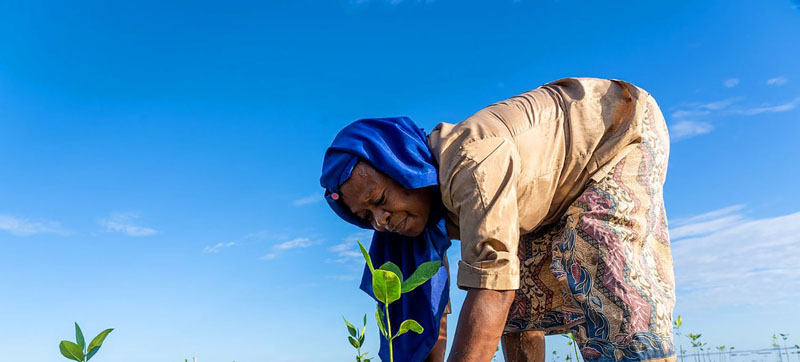
New York: The world is waking up to the importance of mangroves, a senior UN official said on Monday, underscoring the need for everyone to support restoration and protection of these crucial habitats.
Audrey Azoulay, Director General of the UN Educational, Scientific and Cultural Organization (UNESCO), made the appeal in her message for the International Day for the Conservation of the Mangrove Ecosystem, observed on 26 July.
Mangroves are found in tropical and sub-tropical regions, on the boundary between land and sea. Globally, they cover a surface of just 14.8 million hectares, or roughly equivalent to the size of Greece.
Coastal development threat
“They protect biodiversity by sheltering and nurturing marine life. They function like filtration systems, absorbing nutrients and pollutants. They fight coastal erosion, acting as breakwaters to dissipate storm surges and wave energy. Above all, they play an essential role as carbon sinks, sequestering atmospheric and oceanic carbon for long periods of time,” said Ms. Azoulay.
Yet despite these benefits, UNESCO estimated that some countries lost more than 40 per cent of their mangroves between 1980 and 2005, often due to coastal development.
Although human health has always depended on the health of the planet, Ms. Azoulay said the importance of mangrove systems is now increasingly clear.
“The world is now waking up to the importance of mangroves – and other blue carbon ecosystems, including salt marshes, seagrass beds and coastal wetlands,” she said.
Local partnerships
UNESCO strives to conserve mangroves through its work on Global Geoparks and World Heritage Sites, the latter of which alone spans more than 10 per cent of all marine protected areas globally, or 200 million hectares.
The agency’s initiative on Biosphere Reserves, which reconciles biodiversity conservation with sustainable use, also provides “a unique blueprint” for preservation, Ms. Azoulay added.
“In these areas, UNESCO is committed to implementing science-based solutions in coordination with local and indigenous communities, to support humanity’s ability to cope with socio-ecological change,” she said, pointing to examples in Thailand, Senegal, and the United Arab Emirates.
More than 700 sites in 129 countries are part of the UNESCO World Network of Biosphere Reserves, which turns 50 this year, as the UN launches a Decade of Ecosystem Restoration.
“Through these initiatives and others, we are working to protect mangroves and to better support scientific research into these environments,” said Ms. Azoulay.
She urged people everywhere to contribute to conservation efforts “so that, together, we can put a stop to mangrove habitat destruction, and restore what we have already lost.”
Support Our Journalism
We cannot do without you.. your contribution supports unbiased journalism
IBNS is not driven by any ism- not wokeism, not racism, not skewed secularism, not hyper right-wing or left liberal ideals, nor by any hardline religious beliefs or hyper nationalism. We want to serve you good old objective news, as they are. We do not judge or preach. We let people decide for themselves. We only try to present factual and well-sourced news.
Support objective journalism for a small contribution.


