


 Pacific Nations
Prioritize people and planet, UN chief urges Asian and Pacific nations
New York: The UN Secretary-General on Monday called on Asian and Pacific countries not to base their pandemic recovery strategies on “outdated and unsustainable economic models”, and to ensure that the world’s most populous region protects its environment and provides opportunities for all.
In a message to the annual session of the Economic and Social Commission for Asia and the Pacific (ESCAP), Secretary-General António Guterres underlined the 2030 Agenda for Sustainable Development as the blueprint for a strong recovery, leaving no one behind.
“That starts with universal health coverage and social protection, and decent work.”
The UN chief also called for making “peace with nature” and stronger efforts to tackle the climate crisis, including investing in renewable energy, sustainable food systems, and nature-based solutions.
“Looking forward, recovery plans cannot be based on outdated, unsustainable economic models. Investments to rebuild the economy must be centred around inclusive, sustainable development that prioritizes people and planet”, he added.
Theme of the session
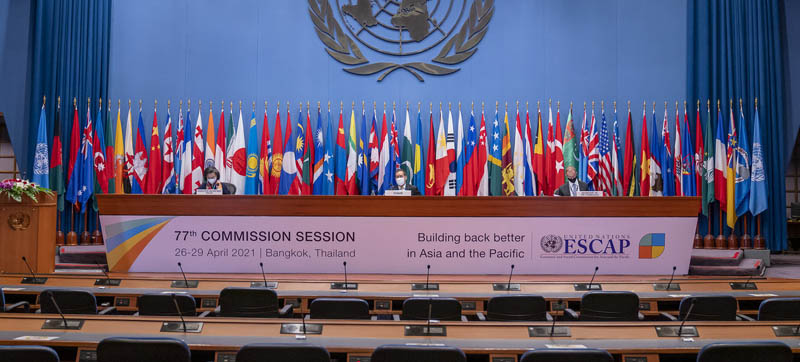
Convened in a virtual setting from 26 to 29 April, countries at the 77th session of ESCAP will discuss how regional cooperation can help countries “build back better” from the pandemic.
Also on the agenda is the impact of the pandemic on the region’s least developed and landlocked developing countries, and small islands, including equitable distribution of vaccines and financial support initiatives, debt reliefs and debt service suspension.
The Commission will also discuss the status of implementation of sustainable development in the region amid the pandemic and its socio-economic fallout, with several countries reeling under successive waves of coronavirus infections.
Established in 1947, ESCAP is the largest of the UN’s five regional commissions – both in terms of geographic coverage and population served – its membership spanning from the Pacific island nation of Kiribati in the east, to Turkey in the west, and Russia in the north, to New Zealand in the south. ESCAP’s membership also includes France, the Netherlands, the United Kingdom, and the United States.
Key areas for recovery
Outlining priorities necessary to ensure a recovery in line with the 2030 Agenda, Armida Salsiah Alisjahbana, Executive Secretary of ESCAP, called on countries to integrate health risk management into their socio-economic strategies, and to scale up of social protection policies to include all segments of the society, especially those working in informal sectors, persons with disabilities, and older persons.
She also underlined the need for sustainable financing, with a focus on investment in resilient economies, as well as strengthening regional trade and transport connectivity to better withstand shocks and disruptions.
In addition, countries must ensure that the COVID-19 recovery is strong, clean and green, Ms. Alisjahbana said.
“It is high time for governments to adopt a climate and environmentally responsive approach in line with the Paris Agreement. Let us urgently invest in renewable energy, energy efficient production system, green infrastructure and ecosystem restoration”, she added.
Support Our Journalism
We cannot do without you.. your contribution supports unbiased journalism
IBNS is not driven by any ism- not wokeism, not racism, not skewed secularism, not hyper right-wing or left liberal ideals, nor by any hardline religious beliefs or hyper nationalism. We want to serve you good old objective news, as they are. We do not judge or preach. We let people decide for themselves. We only try to present factual and well-sourced news.
Support objective journalism for a small contribution.


