


 Low Carbon Scenario
Pollution and climate change upsurge the risk of ‘climate penalty’
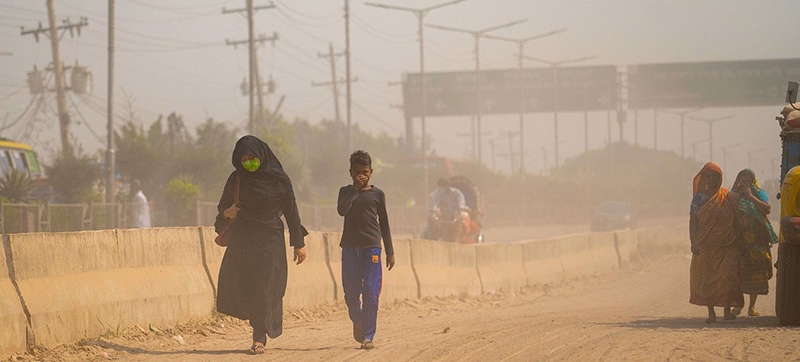
New York: A rise in the frequency, intensity and duration of heatwaves will not only increase wildfires this century but also worsen air quality – harming human health and ecosystems, according to a new report from the World Meteorological Organization (WMO) launched on Wednesday, the International Day of Clean Air for Blue Skies.
“As the globe warms, wildfires and associated air pollution are expected to increase, even under a low emissions scenario,” said WMO Secretary-General Petteri Taalas.
“In addition to human health impacts, this will also affect ecosystems as air pollutants settle from the atmosphere to Earth’s surface”.
‘Foretaste of the future’
The annual WMO Air Quality and Climate Bulletin warned that the interaction between pollution and climate change would impose a “climate penalty” for hundreds of millions of people.
In addition to reporting on the state of air quality and its close interlinkages with climate change, the Bulletin explores a range of possible air quality outcomes under high and low greenhouse gas emission scenarios.
The impact of last year’s wildfire smoke has served to augment this year’s heatwaves.
Mr. Taalas pointed to 2022 heatwaves in Europe and China, describing stable high atmospheric conditions, sunlight and low wind speeds as being “conducive to high pollution levels”.
“This is a foretaste of the future because we expect a further increase in the frequency, intensity and duration of heatwaves, which could lead to even worse air quality, a phenomenon known as the ‘climate penalty’”.
The “climate penalty” refers specifically to the increase in climate change as it impacts the air people breathe.
Air pollutants
The region with the strongest projected climate penalty – mainly Asia – is home to roughly one-quarter of the world's population.
Climate change could exacerbate ozone pollution, which would lead to detrimental health impacts for hundreds of millions of people.
Because air quality and climate are interconnected, changes in one inevitably causes changes in the other.
The Bulletin explains that the combustion of fossil also emits nitrogen oxide, which can react with sunlight to form ozone and nitrate aerosols.
In turn, these air pollutants can negatively affect ecosystem health, including clean water, biodiversity, and carbon storage.
Looking ahead
The Intergovernmental Panel on Climate Change (IPCC) Sixth Assessment Report provides scenarios on the evolution of air quality as temperatures increase throughout this century.
If greenhouse gas emissions remain high, such that global temperatures rise by 3° C from preindustrial levels by the second half of the 21st century, surface ozone levels are expected to increase across heavily polluted areas, particularly in Asia.
This includes a 20 per cent jump across Pakistan, northern India and Bangladesh, and 10 per cent across eastern China.
Fossil fuel emissions will cause ozone increases that will most likely trigger heatwaves, which in turn will amplify air pollution.
Therefore, the heatwaves that are becoming increasingly common due to climate change, are likely to continue degrading air quality.
Low-carbon scenario
To avoid this, the IPCC suggests a low-carbon emissions scenario, which would cause a small, short-term warming prior to temperature decreases.
A future world that follows this scenario would also benefit from reduced nitrogen and sulfur compounds from the atmosphere to the Earth’s surface, where they can damage ecosystems.
WMO stations around the world would monitor the response of air quality and ecosystem health to proposed future emissions reductions.
This could quantify the efficacy of the policies designed to limit climate change and improve air quality.
Support Our Journalism
We cannot do without you.. your contribution supports unbiased journalism
IBNS is not driven by any ism- not wokeism, not racism, not skewed secularism, not hyper right-wing or left liberal ideals, nor by any hardline religious beliefs or hyper nationalism. We want to serve you good old objective news, as they are. We do not judge or preach. We let people decide for themselves. We only try to present factual and well-sourced news.
Support objective journalism for a small contribution.


