


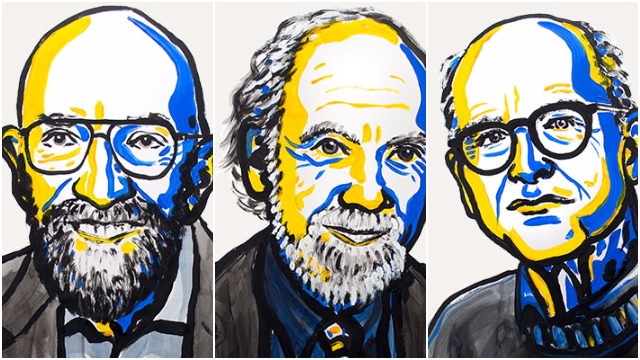
Nobel Prize in physics awarded to three Americans for capturing gravity waves
The three Americans, including Germany born Rainer Weiss, are members of the LIGO-Virgo detector collaboration that discovered gravitational waves.
"This year's prize is about a discovery that shook the world," the Nobel committee representative Göran K. Hansson told a press conference in Stockholm on Tuesday.
On 14 September 2015, the universe's gravitational waves were observed for the very first time. The waves, which were predicted by Albert Einstein a hundred years ago, came from a collision between two black holes. It took 1.3 billion years for the waves to arrive at the LIGO detector in the USA.
The signal was extremely weak when it reached Earth, but is already promising a revolution in astrophysics. Gravitational waves are an entirely new way of observing the most violent events in space and testing the limits of our knowledge.
LIGO, the Laser Interferometer Gravitational-Wave Observatory, is a collaborative project with over one thousand researchers from more than twenty countries. Together, they have realised a vision that is almost fifty years old. The 2017 Nobel Laureates have, with their enthusiasm and determination, each been invaluable to the success of LIGO. Pioneers Rainer Weiss and Kip S. Thorne, together with Barry C. Barish, the scientist and leader who brought the project to completion, ensured that four decades of effort led to gravitational waves finally being observed.
In the mid-1970s, Rainer Weiss had already analysed possible sources of background noise that would disturb measurements, and had also designed a detector, a laser-based interferometer, which would overcome this noise. Early on, both Kip Thorne and Rainer Weiss were firmly convinced that gravitational waves could be detected and bring about a revolution in our knowledge of the universe.
Gravitational waves spread at the speed of light, filling the universe, as Albert Einstein described in his general theory of relativity. They are always created when a mass accelerates, like when an ice-skater pirouettes or a pair of black holes rotate around each other. Einstein was convinced it would never be possible to measure them. The LIGO project's achievement was using a pair of gigantic laser interferometers to measure a change thousands of times smaller than an atomic nucleus, as the gravitational wave passed the Earth.
So far all sorts of electromagnetic radiation and particles, such as cosmic rays or neutrinos, have been used to explore the universe. However, gravitational waves are direct testimony to disruptions in spacetime itself. This is something completely new and different, opening up unseen worlds. A wealth of discoveries awaits those who succeed in capturing the waves and interpreting their message.
About the winners:
Rainer Weiss
.jpg)
Born: 1932, Berlin, Germany
Affiliation at the time of the award: LIGO/VIRGO Collaboration, Massachusetts Institute of Technology (MIT), Cambridge, MA, USA
Prize motivation: "for decisive contributions to the LIGO detector and the observation of gravitational waves"
Prize share: 1/2
Barry C. Barish
Born: 1936, Omaha, NE, USA
Affiliation at the time of the award: LIGO/VIRGO Collaboration, California Institute of Technology (Caltech), Pasadena, CA, USA
Prize motivation: "for decisive contributions to the LIGO detector and the observation of gravitational waves"
Prize share: 1/4
Kip S. Thorne
Born: 1940, Logan, UT, USA
Affiliation at the time of the award: LIGO/VIRGO Collaboration, California Institute of Technology (Caltech), Pasadena, CA, USA
Prize motivation: "for decisive contributions to the LIGO detector and the observation of gravitational waves"
Prize share: 1/4
Image: Nobel Media /Nobel Prize Official Website
Support Our Journalism
We cannot do without you.. your contribution supports unbiased journalism
IBNS is not driven by any ism- not wokeism, not racism, not skewed secularism, not hyper right-wing or left liberal ideals, nor by any hardline religious beliefs or hyper nationalism. We want to serve you good old objective news, as they are. We do not judge or preach. We let people decide for themselves. We only try to present factual and well-sourced news.
Support objective journalism for a small contribution.


