


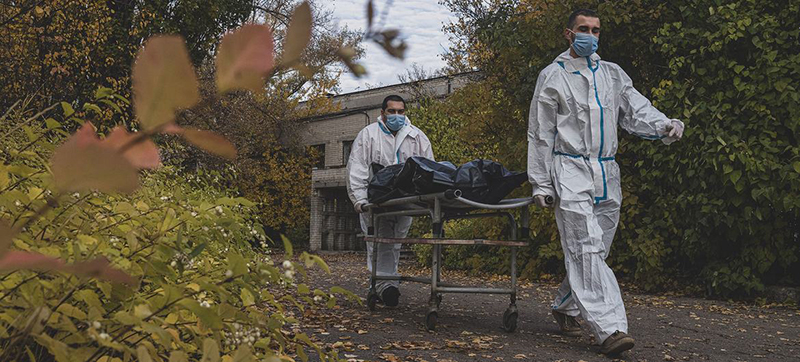
 COVID-19 Deaths
Nearly 15 million deaths directly or indirectly linked to COVID-19
New York: Approximately 14.9 million deaths globally were directly or indirectly associated with the COVID-19 pandemic by the end 2021, the World Health Organization (WHO) said on Thursday in new data on excess mortality attributable to the disease.
The figure represents 9.5 million more deaths than those reported so far, directly attributed to COVID-19.
Excess mortality is calculated as the difference between the number of deaths that have occurred and the number that would be expected, in the absence of the pandemic, the UN agency explained.
‘Sobering data’
It includes people who died from the coronavirus disease, or those who died indirectly from the pandemic’s impact on health systems and communities where they live, such as people with other health conditions who were unable to access vital care.
“These sobering data not only point to the impact of the pandemic but also to the need for all countries to invest in more resilient health systems that can sustain essential health services during crises, including stronger health information systems,” said Tedros Adhanom Ghebreyesus, the WHO Director-General.
The data cover the period from 1 January 2020 to 31 December 2021, with the estimated range of excess mortality at 13.3 million to 16.6 million.
A more objective picture
The number of excess deaths per 100,000 gives a more objective picture of the pandemic than reported COVID-19 mortality data, WHO said.
Most excess deaths, 84 per cent, were concentrated in Southeast Asia, Europe, and the Americas, and nearly 70 per cent in just 10 countries globally.
Middle-income nations account for 81 per cent of the 14.9 million excess deaths, while high-income and low-income countries account for 15 per cent and four per cent, respectively.
The estimates also revealed that the global death toll was higher for men than women - 57 per cent compared to 43 per cent – and higher among older persons.
Understanding the impact
Dr Samira Asma, WHO’s Assistant Director-General for Data, Analytics and Delivery, said measurement of excess mortality is an essential component in understanding the pandemic’s impact.
“Shifts in mortality trends provide decision-makers information to guide policies to reduce mortality and effectively prevent future crises. Because of limited investments in data systems in many countries, the true extent of excess mortality often remains hidden,” she said.
Collaboration and innovation
The production of the estimates is a result of a global collaboration supported by the work of the Technical Advisory Group for COVID-19 Mortality Assessment, as well as country consultations.
The expert group is convened jointly by WHO and the UN Department of Economic and Social Affairs (UN DESA).
“The United Nations system is working together to deliver an authoritative assessment of the global toll of lives lost from the pandemic. This work is an important part of UN DESA’s ongoing collaboration with WHO and other partners to improve global mortality estimates,” said Liu Zhenmin, UN Under-Secretary-General for Economic and Social Affairs.
The panel developed an innovative methodology to generate comparable mortality estimates even where data are incomplete or unavailable.
The methods rely on a statistical model derived using information from countries with adequate data, and the model is used to generate estimates for those countries with little or no data available.
The methodology has been invaluable, WHO said, as many countries still lack capacity for reliable mortality surveillance. Therefore, they do not collect and generate the data needed to calculate excess mortality.
Support Our Journalism
We cannot do without you.. your contribution supports unbiased journalism
IBNS is not driven by any ism- not wokeism, not racism, not skewed secularism, not hyper right-wing or left liberal ideals, nor by any hardline religious beliefs or hyper nationalism. We want to serve you good old objective news, as they are. We do not judge or preach. We let people decide for themselves. We only try to present factual and well-sourced news.
Support objective journalism for a small contribution.


