


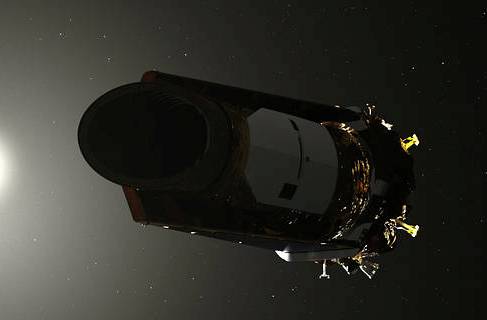
NASA's Kepler Spacecraft pauses science observations to download science data
Washington, July 7 (IBNS): Earlier this week, NASA’s Kepler team received an indication that the spacecraft fuel tank is running very low.
NASA has placed the spacecraft in a hibernation-like state in preparation to download the science data collected in its latest observation campaign, read the NASA website.
Once the data has been downloaded, the expectation is to start observations for the next campaign with any remaining fuel.
Since May 12, Kepler has been on its 18th observation campaign, staring at a patch of sky towards the constellation of Cancer it previously studied in 2015.
The data from this second look will provide astronomers with an opportunity to confirm previous exoplanet candidates and discover new ones. Returning the data back to Earth is the highest priority for the remaining fuel.
To bring the data home, the spacecraft must point its large antenna back to Earth and transmit the data during its allotted Deep Space Network time, which is scheduled in early August.
Until then, the spacecraft will remain stable and parked in a no-fuel-use safe mode.
On August 2, the team will command the spacecraft to awaken from its no-fuel-use state and maneuver the spacecraft to the correct orientation and downlink the data.
If the maneuver and download are successful, the team will begin its 19th observation campaign on August 6 with the remaining fuel.
NASA will provide an update after the scheduled download.
The agency has been monitoring the Kepler spacecraft closely for signs of low fuel, and expects it to run out of fuel in the next few months.
As engineers preserve the new data stored on the spacecraft, scientists are continuing to mine existing data already on the ground.
Among other findings, recently 24 new planet discoveries were made using data from the 10th observation campaign, adding to the spacecraft’s growing bounty of 2,650 confirmed planets.
NASA's Ames Research Center in California's Silicon Valley manages the Kepler mission and follow-up K2 mission for NASA’s Science Mission Directorate. NASA's Jet Propulsion Laboratory in Pasadena, California, managed Kepler mission development.
Ball Aerospace & Technologies Corporation in Boulder, Colorado, operates the flight system with support from the Laboratory for Atmospheric and Space Physics at the University of Colorado in Boulder.
Image: NASA website
Support Our Journalism
We cannot do without you.. your contribution supports unbiased journalism
IBNS is not driven by any ism- not wokeism, not racism, not skewed secularism, not hyper right-wing or left liberal ideals, nor by any hardline religious beliefs or hyper nationalism. We want to serve you good old objective news, as they are. We do not judge or preach. We let people decide for themselves. We only try to present factual and well-sourced news.
Support objective journalism for a small contribution.


