


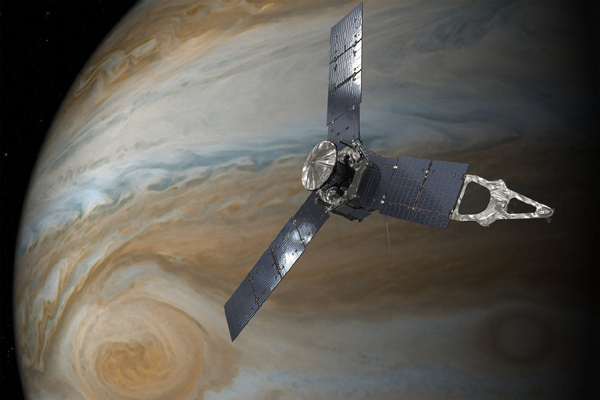
NASA Juno Mission prepares for Dec 11 Jupiter flyby
At the time of closest approach (called perijove), Juno will be about 2,580 miles (4,150 kilometers) above the gas giant’s roiling cloud tops and traveling at a speed of about 129,000 mph (57.8 kilometers per second) relative to the planet. Seven of Juno’s eight science instruments will be energized and collecting data during the flyby, read the NASA website.
"This will be the first time we are planning to operate the full Juno capability to investigate Jupiter's interior structure via its gravity field,” said Scott Bolton, principal investigator of Juno from the Southwest Research Institute in San Antonio. “We are looking forward to what Jupiter’s gravity may reveal about the gas giant's past and its future.”
Mission managers have decided not to collect data with the Jovian Infrared Auroral Mapper (JIRAM) instrument during the December flyby, to allow the team to complete an update to the spacecraft software that processes JIRAM’s science data. A software patch allowing JIRAM’s operation is expected to be available prior to the next perijove pass (PJ4) on Feb. 2, 2017.
The spacecraft team continues to weigh its options regarding modifications of Juno’s orbital period -- how long it takes for the spacecraft to complete one orbit around Jupiter.
At present, Juno’s orbital period is 53.4 days. There had been plans to perform a period adjustment maneuver with the spacecraft’s main engine on Oct. 19 to reduce the orbital period to 14 days.
The team made the decision to forgo the maneuver in order to further study the performance of a set of valves that are part of the spacecraft's fuel pressurization system.
The period reduction maneuver was the final scheduled burn of Juno's main engine.
"We have a healthy spacecraft that is performing its mission admirably,” said Rick Nybakken, project manager for Juno from NASA’s Jet Propulsion Laboratory in Pasadena, California. “What we do not want to do is add any unnecessary risk, so we are moving forward carefully.”
In collaboration with NASA and the Juno team, Apple will release an interactive guide to the mission (an iBook) on Dec. 11.
The Juno spacecraft launched on Aug. 5, 2011, from Cape Canaveral, Florida, and arrived at Jupiter on July 4, 2016.
During its mission of exploration, Juno soars low over the planet's cloud tops -- as close as about 2,600 miles (4,100 kilometers).
During these flybys, Juno will probe beneath the obscuring cloud cover of Jupiter and study its auroras to learn more about the planet's origins, structure, atmosphere and magnetosphere.
Juno's name comes from Roman mythology.
The mythical god Jupiter drew a veil of clouds around himself to hide his mischief, and his wife -- the goddess Juno -- was able to peer through the clouds and reveal Jupiter's true nature.
JPL manages the Juno mission for the principal investigator, Scott Bolton, of Southwest Research Institute in San Antonio. Juno is part of NASA's New Frontiers Program, which is managed at NASA's Marshall Space Flight Center in Huntsville, Alabama, for NASA's Science Mission Directorate. Lockheed Martin Space Systems, Denver, built the spacecraft. Caltech in Pasadena, California, manages JPL for NASA.
Image Credits: NASA/JPL-Caltech
Support Our Journalism
We cannot do without you.. your contribution supports unbiased journalism
IBNS is not driven by any ism- not wokeism, not racism, not skewed secularism, not hyper right-wing or left liberal ideals, nor by any hardline religious beliefs or hyper nationalism. We want to serve you good old objective news, as they are. We do not judge or preach. We let people decide for themselves. We only try to present factual and well-sourced news.
Support objective journalism for a small contribution.


