


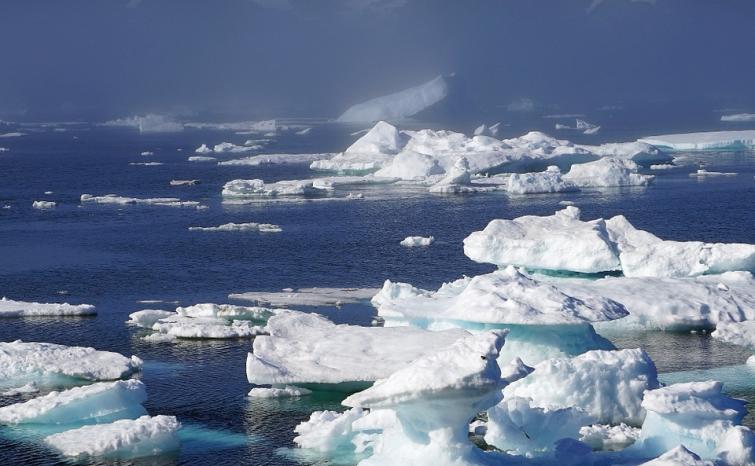
Melting Arctic Sea ice linked to emergence of deadly virus in marine mammals: Study
London/IBNS: Scientists have linked the decline in Arctic sea ice to the emergence of a deadly virus that could threaten marine mammals in the North Pacific, according to a study from the University of California, Davis.
Phocine distemper virus, or PDV, a pathogen responsible for killing thousands of European harbor seals in the North Atlantic in 2002, was identified in northern sea otters in Alaska in 2004, raising questions about when and how the virus reached them.
The 15-year study, published today in the journal Scientific Reports, highlights how the radical reshaping of historic sea ice may have opened pathways for contact between Arctic and sub-Arctic seals that was previously impossible. This allowed for the virus’ introduction into the Northern Pacific Ocean, UC Davis School of Veterinary Medicine website said.
“The loss of sea ice is leading marine wildlife to seek and forage in new habitats and removing that physical barrier, allowing for new pathways for them to move,” said corresponding author Tracey Goldstein, associate director of the One Health Institute at the UC Davis School of Veterinary Medicine. “As animals move and come in contact with other species, they carry opportunities to introduce and transmit new infectious disease, with potentially devastating impacts.”
As ice melts, a virus on the move
Researchers sampled marine mammals for phocine distemper virus exposure and infection from 2001 to 2016. Sampled mammals included ice-associated seals, northern fur seals, Steller sea lions and northern sea otters from Southeast Alaska to Russia along the Aleutian Islands and the Bering, Chukchi and Beaufort seas.
Arctic ocean sea ice and open water routes were assessed from the North Atlantic to North Pacific oceans. Satellite telemetry data helped the researchers link animal movement and risk factor data to demonstrate that exposed animals have the potential to carry phocine distemper virus long distances.
The authors identified widespread infection and exposure to the virus across the North Pacific Ocean beginning in 2003, with a second peak of exposure and infection in 2009. These peaks coincided with reductions in Arctic sea ice extent.
“As sea ice continues its melting trend, the opportunities for this virus and other pathogens to cross between North Atlantic and North Pacific marine mammals may become more common,” said first author Elizabeth VanWormer, a postdoctoral researcher at UC Davis during the study and currently an assistant professor at the University of Nebraska, Lincoln. “This study highlights the need to understand PDV transmission and the potential for outbreaks in sensitive species within this rapidly changing environment.”
Support Our Journalism
We cannot do without you.. your contribution supports unbiased journalism
IBNS is not driven by any ism- not wokeism, not racism, not skewed secularism, not hyper right-wing or left liberal ideals, nor by any hardline religious beliefs or hyper nationalism. We want to serve you good old objective news, as they are. We do not judge or preach. We let people decide for themselves. We only try to present factual and well-sourced news.
Support objective journalism for a small contribution.


