


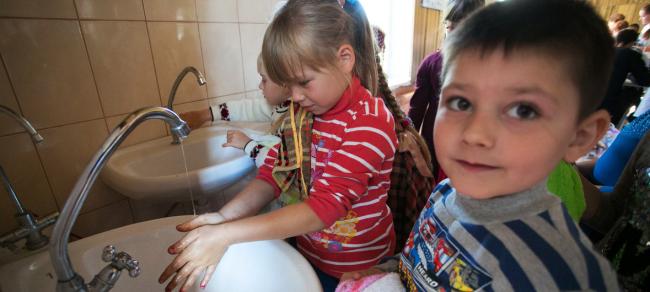
Lack of access to clean water, toilets puts children’s education at risk, says UN
New York, Aug Aug 28 (IBNS): Millions of children are going to school without basic hygiene facilities, and the goal of universal access to basic water, sanitation and hygiene remains “a huge challenge,” the United Nations warned on Monday
A new joint UN agency study, Drinking Water, Sanitation and Hygiene in Schools: 2018 Global Baseline Report, says that good hygiene facilities in schools provide the basis of a healthy learning environment, and that girls are more likely to attend when they are on their period.
Moreover, children who pick up good hygiene habits at school can reinforce positive life-long behaviours in their homes and communities, says the report.
However, millions of children are going to school without basic hygiene facilities: over 30 per cent of schools worldwide do not provide safe drinking water; a third of schools do not provide the most basic of toilet facilities (such as septic tank, pit latrines or composting toilets); and nearly 900 million children go to schools with no handwashing facilities with soap and water.
The annual report is produced by the World Health Organization/UN Children’s Fund Joint Monitoring Programme, or JMP, which has been monitoring global progress on drinking water, sanitation and hygiene since 1990.
It looks at the progress made towards reaching the targets of two of the Sustainable Development Goals (SDGs): Goal 6(Clean water and sanitation), and Goal 4 (Ensure inclusive and equitable quality education and promote lifelong learning opportunities for all).
Commenting on the report, Kelly Ann Naylor, Global Chief of Water, Sanitation and Hygiene at UNICEF, said that “If education is the key to helping children escape poverty, access to water and sanitation is key to helping children safely maximize their education. To neglect this is to be careless with the well-being and health of children,"
Universal access to basic water, sanitation and hygiene in schools is part of the 2030 Agenda for Sustainable Development, but achieving this ambitious target presents a huge challenge. The JMP has designed tools to make it easier to track progress across countries, towards a basic level of drinking water, sanitation and hygiene service.
UNICEF/Aleksey Filippov
Support Our Journalism
We cannot do without you.. your contribution supports unbiased journalism
IBNS is not driven by any ism- not wokeism, not racism, not skewed secularism, not hyper right-wing or left liberal ideals, nor by any hardline religious beliefs or hyper nationalism. We want to serve you good old objective news, as they are. We do not judge or preach. We let people decide for themselves. We only try to present factual and well-sourced news.
Support objective journalism for a small contribution.


