


 Island
Island States must bolster resilience to existential climate threats
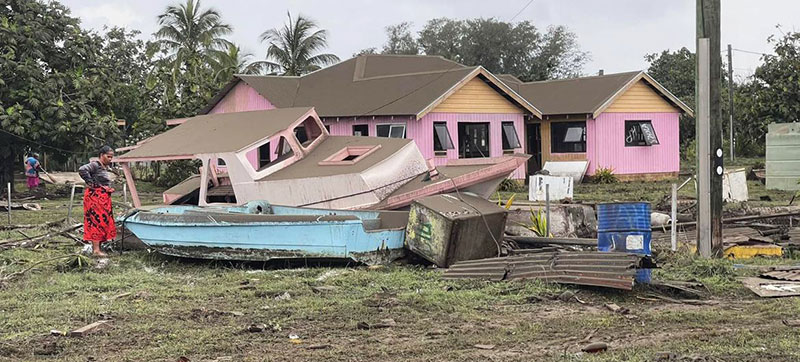
New York: The massive volcanic eruption and tsunami in Tonga followed by another earthquake and aftershocks just days afterwards, has highlighted once again the vulnerability of Small Island Developing States (SIDS), a meeting this week convened by the Food and Agriculture Organization (FAO) has heard.
The Global SIDS Solutions Dialogue, focused on the “severe challenge” these often impoverished low-lying nations face in being able to reach the goals of the UN’s 2030 Agenda for Sustainable Development, said FAO Chief Economist, Máximo Torero Cullen.
It also highlighted the pressing need to fortify their resilience to climate change, natural disasters and other external shocks, including the COVID-19 pandemic.
Making SIDS a priority
In his opening remarks, Mr. Torero Cullen said that this was why the agency has made “a concerted decision to prioritize activities for these countries and are working closely with SIDS networks and constituencies, to implement them”.
He explained that FAO is supporting SIDS “to build back better and achieve better production, better nutrition, better environment and a better life”.
Adding that these are the basis of the UN agency’s new strategic framework “to ensure more efficient, inclusive, resilient and sustainable agri-food systems, thereby combating hunger, malnutrition, poverty and inequality”.
Robust food systems
With around 65 million inhabitants, SIDS account for only one per cent of carbon dioxide emissions, and yet they are most vulnerable to the existential threat posed by the impacts of climate change.
While fisheries, tourism and agriculture contribute significantly to their economies, the vulnerability of these sectors raises challenges for them to produce sufficient food to meet the needs of their populations.
“Climate change and the pandemic have made clear the need for SIDS to develop resilient and local food systems”, said Maldivian Ambassador and climate advocate, Thilmeeza Hussain.
Reliance on imports
SIDS in the Caribbean, the Pacific, and many small islands in the Atlantic and Indian Ocean - together with the South China Sea - depend on food imports.
Nearly all SIDS import 60 per cent of their food and 50 per cent of island States bring in more than 80 per cent.
As such, they are particularly affected by disruptions in supply chains and international trade, including flight cancellations, slowdowns in the shipping industry and logistics bottlenecks.
To recover from COVID-19 and reach the Sustainable Development Goals (SDGs), Mr. Torero Cullen stressed the importance of identifying homegrown solutions and harnessing innovation with digitalization as a force multiplier to accelerate the process.
“Digital technologies can improve the sustainability and efficiency of agri-food system in SIDS by empowering farmers to become more productive, to better access markets, to reduce waste, and to make agricultural practices more eco-friendly”, said Hani Eskandar of the International Telecommunication Union’s (ITU).
Finding solutions
The global dialogue was jointly organized by the FAO Liaison Offices in Brussels, Geneva, New York as well as in the FAO Office of SIDS, Least Developed Countries and Landlocked Developing Countries to inform governments and development partners of the outcomes of the SIDS Solutions Forum held in Fiji last August.
That Forum launched a knowledge exchange platform to promote, scale up and replicate locally grown ideas, to accelerate agriculture, food, environment and health-related SDGs.
Support Our Journalism
We cannot do without you.. your contribution supports unbiased journalism
IBNS is not driven by any ism- not wokeism, not racism, not skewed secularism, not hyper right-wing or left liberal ideals, nor by any hardline religious beliefs or hyper nationalism. We want to serve you good old objective news, as they are. We do not judge or preach. We let people decide for themselves. We only try to present factual and well-sourced news.
Support objective journalism for a small contribution.


