


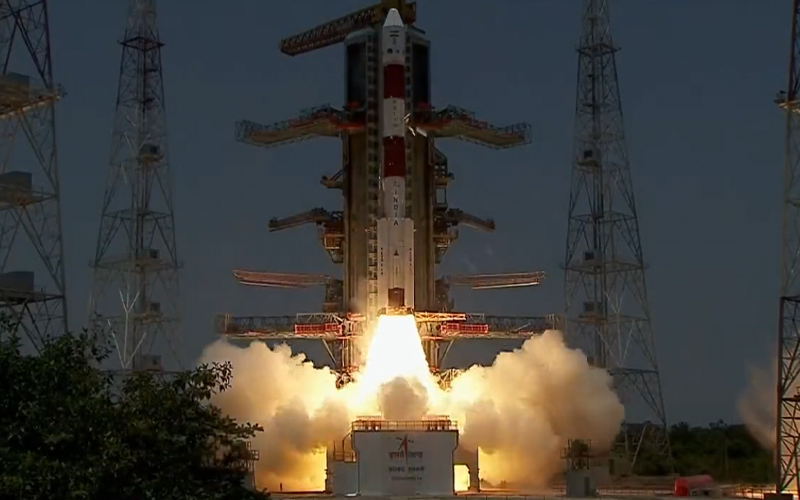
 Aditya-L1
India launches maiden solar mission Aditya-L1
In another success for Indian Space Research Organisation (ISRO), India successfully launched its maiden solar mission Aditya L-1 from Sriharikota on Saturday.
Aditya-L1 has been launched from Satish Dhawan Space Centre in Sriharikota, Andhra Pradesh, days after India's lunar mission, Chandrayaan-3, successfully landed on the Moon.
Aditya-L1 will be 1.5 million kilometers away from the Earth.
It will approximately take 125 days to reach the Sun.
ISRO is using its workhorse and reliable launch vehicle PSLV-C57 for the mission.
VIDEO | Aditya L1, India's maiden solar mission, launched from Satish Dhawan Space Centre (SDSC) SHAR in Sriharikota, Andhra Pradesh.
— Press Trust of India (@PTI_News) September 2, 2023
(Source: @isro) #AdityaL1Launch #AdityaL1Mission pic.twitter.com/PEwsUVp08E
Is Aditya-L1 a complete Mission to study the Sun? No, says ISRO
ISRO said its maiden Solar exploratory Mission Aditya-L1 is not a complete one to study the Sun due to limited mass, power and volume of the spacecraft that carries scientific payloads in space.
"Is Aditya-L1 a complete Mission to study the Sun. The obvious answer is a ‘NO’ which is not only true for Aditya-L1 but in general for any space mission," ISRO said.
The reason is that due to the limited mass, power and volume of the spacecraft that carries the scientific payloads in space, only a limited set of instruments with limited capacity can be sent onboard the spacecraft, the Space Agency said.
In case of Aditya-L1, all the measurements will be made from the Lagrange point L1. As an example, the various phenomena of the sun are multi-directional and therefore the directional distribution of energy of explosive/eruptive phenomena will not be possible to study with Aditya-L1 alone, it added.
Another Lagrange point known as L5 is a good vantage point for studying the Earth directed CME events and assessing the space weather.
Also, the polar regions of the sun are not well studied due to technological challenges of achieving spacecraft orbits for such studies.
"The sun's polar dynamics and magnetic fields are believed to play an important role in deriving the solar cycles.
"Further, the polarisation measurements of solar radiations at different wavelengths are required to understand the various processes occurring in and around the sun, ISRO said.
Support Our Journalism
We cannot do without you.. your contribution supports unbiased journalism
IBNS is not driven by any ism- not wokeism, not racism, not skewed secularism, not hyper right-wing or left liberal ideals, nor by any hardline religious beliefs or hyper nationalism. We want to serve you good old objective news, as they are. We do not judge or preach. We let people decide for themselves. We only try to present factual and well-sourced news.
Support objective journalism for a small contribution.


