


 Environment
India crosses 300 GW clean energy mark, races towards 500 GW 2030 target
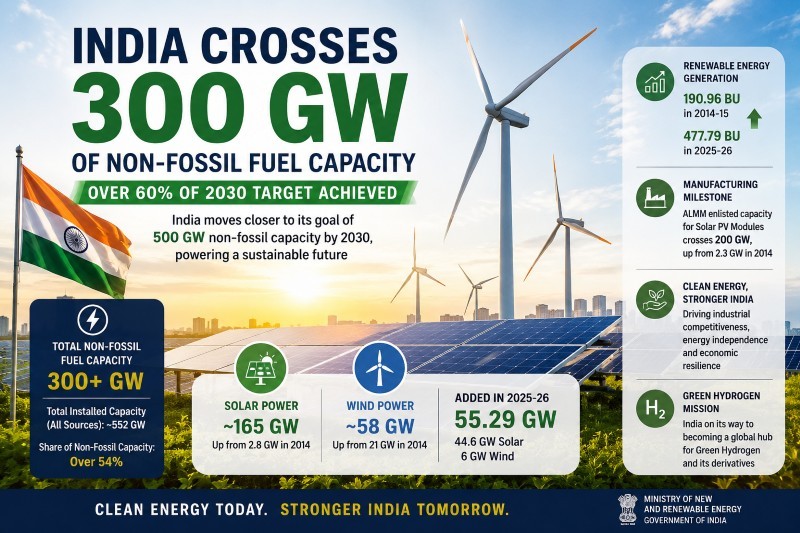
The Indian government has said the country has crossed 300 GW of non-fossil fuel-based installed electricity generation capacity, reaching more than 60% of the 500 GW target set for 2030.
The share of non-fossil fuel-based capacity in India’s total installed electricity generation capacity, which currently stands at around 552 GW, has risen to more than 54%, according to a government statement.
“Backed by the key policy enablers provided by the government for this transformation, this monumental achievement highlights India’s rapid progress towards building an Aatmanirbhar energy ecosystem and securing the target of 500 GW non-fossil capacity by 2030,” the statement said.
Also Read: Tiger-striped taxis hit Kolkata streets to roar for wildlife conservation
The growth in clean energy capacity has been driven by strong contributions from multiple sectors. Solar power remains the key growth engine, with installed capacity reaching around 165 GW, up from just 2.8 GW in 2014.
The wind energy sector has also recorded significant growth, with installed capacity crossing 58 GW, compared with 21 GW in 2014.
During 2025-26, India added a record 55.29 GW of non-fossil fuel-based electricity generation capacity, including 44.6 GW of solar power and 6 GW of wind power.
The rapid expansion of renewable energy capacity has also translated into higher generation. Renewable energy generation increased from 190.96 billion units (BU) in 2014-15 to 477.79 BU in 2025-26, according to the government.
Also Read: Wildfires rage across France, Spain as flames near Bordeaux, hundreds of thousands evacuated
To support this expansion and strengthen domestic supply chains, India has also significantly expanded its renewable energy manufacturing capabilities. Driven by the Production Linked Incentive (PLI) scheme, which focuses on high-efficiency, domestically manufactured solar modules, the enlisted capacity under the Approved List of Models and Manufacturers (ALMM) for solar PV modules has crossed the 200 GW milestone, up from just 2.3 GW in 2014.
The government said the clean energy transition is no longer limited to climate commitments but has become central to strengthening India’s industrial competitiveness, energy security and economic resilience.
The Ministry of New and Renewable Energy (MNRE) is also advancing industrial decarbonisation through the National Green Hydrogen Mission, with the aim of positioning India as a global hub for the production, use and export of green hydrogen and its derivatives.
Support Our Journalism
We cannot do without you.. your contribution supports unbiased journalism
IBNS is not driven by any ism- not wokeism, not racism, not skewed secularism, not hyper right-wing or left liberal ideals, nor by any hardline religious beliefs or hyper nationalism. We want to serve you good old objective news, as they are. We do not judge or preach. We let people decide for themselves. We only try to present factual and well-sourced news.
Support objective journalism for a small contribution.


