


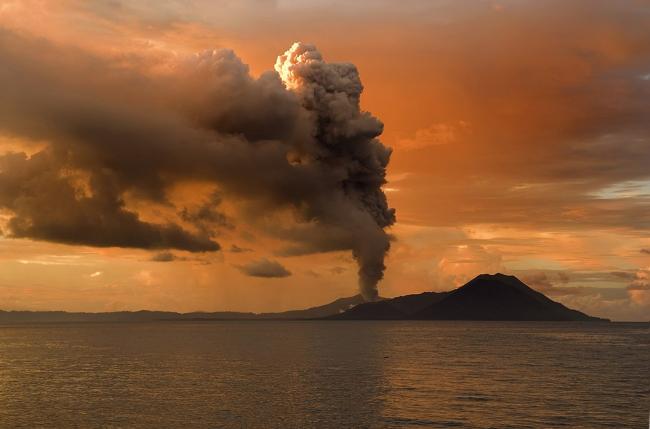
Humans flourished through super volcanic eruption 74,000 years ago, finds study
Las Vegas, Mar 17 (IBNS): Our ancestors not only survived a massive volcanic eruption 74,000 years ago, they flourished during the resulting climate change that occurred, a new study by UNLV geoscientist Eugene Smith and colleagues found.
The conclusions reached by Smith and Arizona State University archeologist Curtis Marean counter previously held beliefs that the eruption of an Indonesian super volcano – called Mount Toba – and the resulting “winter” of ash and smoke spread thousands of miles, destroyed plants, killed animals, and nearly wiped out humans, read the UNLV website.
The study, “Humans thrived in South Africa through the Toba eruption about 74,000 years ago,” was published this week in the journal Nature.
And it all started with a National Geographic vacation and tour to the Republic of South Africa that Smith and his wife took back in 2011.
During the vacation, the couple was touring archeological sites run by Marean, who noticed a skeptical look on Smith’s face as he discussed geology.
The two soon spoke, and Marean learned Smith was a geologist and asked him to look at some glassy looking shards that were found in the archeological sites. Smith quickly identified the pieces as cryptotephra, very old microscopic glass shards that were ejected during a volcanic eruption.
The next step was creating a partnership between the two public research universities and to build a lab to study when and where those shards came from.
Smith sent a UNLV graduate student to Oxford University in the United Kingdom to model the lab. Soon after, UNLV developed the Cryptotephra Laboratory for Archaeological and Geological Research, the only U.S. lab specializing in this type of work. The lab analyzed and dated the shards, narrowing down the exact time that all this occurred to inhabitants at two sites -- Pinnacle Point and Vleesbaai in present-day South Africa.
Of course, they first had to find more shards of glass. This is no easy task when you’re talking about something less than a one-third the size of a grain of salt.
Smith and a graduate student went to South Africa and collected samples from the Pinnacle Point archaeological site looking for evidence of the Toba super volcano. The shards are both tiny and hard to come by – roughly 1 in every 10,000 grains of sand, he said.
Back in the lab, Smith and UNLV post-doctoral fellow Racheal Johnsen, graduate student Amber Ciravolo, and undergraduate Shelby Fitch studied samples of the glass to trace it to the Toba super volcano.
Armed with a clear timeline, the archeologist Marean was able to show that those human ancestors living at Pinnacle Point and Vleesbaai – located about five miles apart -- showed remarkable improvement in their life style during the volcanic winter caused by the Toba eruption.
“Humans in this region thrived through the Toba event and the ensuing full glacial conditions, perhaps as a combined result of the uniquely rich resource base of the region and fully evolved modern human adaptation,” study authors noted.
The Toba eruption – the largest in the past 2 million years -- was so immense, it spewed ash and smoke around the world, including South Africa, some 6,200 miles away.
Still, humans were able to survive and adapt, Smith said.
“This was eight years of work by many people, and I’m immensely proud of my colleagues and our lab at UNLV,” Smith said.
Representative Image: Wkimedia Commons
Support Our Journalism
We cannot do without you.. your contribution supports unbiased journalism
IBNS is not driven by any ism- not wokeism, not racism, not skewed secularism, not hyper right-wing or left liberal ideals, nor by any hardline religious beliefs or hyper nationalism. We want to serve you good old objective news, as they are. We do not judge or preach. We let people decide for themselves. We only try to present factual and well-sourced news.
Support objective journalism for a small contribution.


