


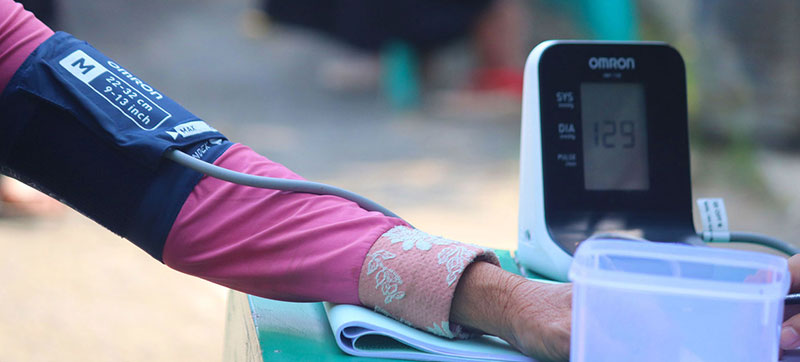
 Blood Pressure
High blood pressure now more common in low and middle-income countries, new report finds
New York: The vast majority of people with high blood pressure, or hypertension, – a serious medical condition that significantly increases the risks of heart, brain, kidney and other diseases – live in low and middle-incomes countries, a World Health Organization (WHO) report released on Wednesday has revealed.
The study, which was co-led by Imperial College London, found that 82 per cent of all people with hypertension, around one billion, live in low and middle-income countries.
The researchers found that Canada, Peru and Switzerland had among the lowest prevalence of hypertension in the world in 2019, while some of the highest rates were seen in the Dominican Republic, Jamaica and Paraguay for women and Hungary, Paraguay and Poland for men.
A ‘public health failure'
Although it is straightforward to diagnose hypertension and relatively easy to treat the condition with low-cost drugs, the study revealed significant gaps in diagnosis and treatment. About 580 million people with hypertension were unaware of their condition because they were never diagnosed. The study also indicated that more than half of people with hypertension, or a total of 720 million people, were not receiving the treatment that they needed.
Men and women in Canada, Iceland and the Republic of Korea were most likely to receive medication to treat and control their hypertension, with more than 70 per cent of those with the condition receiving treatment in 2019. In comparison, men and women in sub-Saharan Africa, central, south and south-east Asia, and Pacific Island nations are the least likely to be receiving medication.
Professor Majid Ezzati, senior author of the study and Professor of Global Environmental Health at the School of Public Health at Imperial College London, said: “Nearly half a century after we started treating hypertension, which is easy to diagnose and treat with low-cost medicines, it is a public health failure that so many of the people with high blood pressure in the world are still not getting the treatment they need.”
The overall number of adults aged 30-79 years with hypertension has doubled from 650 million to 1.28 billion. However, this is primarily down to population growth and ageing, and the percentage of people who have hypertension has changed little since 1990.
Support Our Journalism
We cannot do without you.. your contribution supports unbiased journalism
IBNS is not driven by any ism- not wokeism, not racism, not skewed secularism, not hyper right-wing or left liberal ideals, nor by any hardline religious beliefs or hyper nationalism. We want to serve you good old objective news, as they are. We do not judge or preach. We let people decide for themselves. We only try to present factual and well-sourced news.
Support objective journalism for a small contribution.


