


 Food Cycle
From farm to fork: How food systems can power climate action
New York: Taking specific steps to transform national food supply systems can help countries achieve climate goals and limit global warming to 1.5 degree Celsius, a new joint UN report on climate action has found.
Enhancing Nationally Determined Contributions for Food Systems, published on Tuesday, by the UN Environment Programme (UNEP), WWF, EAT, and Climate Focus, also reveals that nations are missing significant opportunities to reduce greenhouse gas emissions.
It also identifies sixteen ways policymakers could take more action, from farm to fork, to integrate food systems in their national climate strategies, that could also help improve food security.
According to the head of UNEP, while COVID-19 has exposed the fragility of food supply systems, the pandemic has also demonstrated that businesses and people are ready to build back better.
“This crisis offers us a chance to radically rethink how we produce and consume food”, Inger Andersen, Executive Director of UNEP, said in a news release announcing the report’s findings.
“For example, reorienting consumption by halving food waste and catalyzing a shift towards more plant-rich diets, is also a powerful climate mitigation tool to take advantage of. It is up to us to seize this opportunity and put sustainable food systems at the heart of the green recovery,” she added.
Improvements by as much as 25 per cent
Currently, diets and food loss and waste are widely ignored in national climate plans, but by adding them, policymakers can improve their mitigation and adaptation contributions from food systems, by as much as 25 per cent, said UNEP.
Under the 2015 Paris Agreement on Climate Change, every five years, countries are expected to revise or resubmit their Nationally Determined Contributions (NDCs) – steps that they will take to reduce national emissions and adapt to the impacts of climate change.
2020, therefore, presents policymakers with the opportunity to adopt food systems solutions and set more ambitious targets to reduce greenhouse gas emissions and, in turn, improve biodiversity, food security and public health.
Food: more than a third of emissions
Food systems – which gather all elements and activities that relate to the production, processing, distribution, preparation and consumption of food – account for up to 37 per cent of all greenhouse gas emissions, offering plenty of space to improve.
Marco Lambertini, Director General of WWF-International, called on governments to include climate and nature positive food systems approaches in revised and more ambitious NDCs submitted in 2020.
“Without action on how we produce and consume food, we cannot achieve our climate or biodiversity goals, which are the foundation to achieve food security, prevent the emergence of diseases and ultimately deliver the Sustainable Development Goals (SDGs).”
Affordable and accessible diets
Gunhild Stordalen, the Founder and Executive Chair of EAT – a non-profit organization that works towards catalyzing a global food system transformation – added that fixing food systems goes beyond supporting the implementation of the 2030 Agenda for Sustainable Development and the Paris Agreement.
“Shifting to regenerative, carbon-absorbing production and adoption of healthy, predominantly plant-based diets that are affordable and accessible, as well as halving food waste and loss, are crucial actions that must be included in countries’ NDCs and integrated in their climate action plans with clear ambitions,” she said.
“As we enter the Decade of Action, let’s make it the decade of delivery for a healthy, sustainable and equitable food future for all,” added Dr. Stordalen.
The sixteen actions identified in the report include reducing land-use change and conversion of natural habitats, which could reduce emissions by some 4.6 gigatonnes of equivalent carbon dioxide, or Gt CO2e, per year. Action towards transformation
Comparably, reducing food loss and waste, which accounts for 8 per cent of all greenhouse gas emissions, could reduce emissions by 4.5 Gt CO2e per year. Similarly, improving production methods and reducing methane emissions from livestock, could reduce emissions by up to 1.44 Gt CO2e per year.
Much greater reductions, could be achieved by shifting to healthier and more sustainable diets with a higher proportion of plant-based than animal-based foods could avoid emissions of up to 8 Gt CO2e each year. But, no current national climate plans explicitly discuss more sustainable diets.
“Eliminating excessive meat consumption, improving storage facilities and reducing food waste is good for our health and improves food security,” said Charlotte Streck, Co-founder and Director of Climate Focus, a think tank that provides advice on international climate policy to public and private actors across the globe.
“With a check-list and concrete examples of activities and targets, this report provides guidance for policymakers to integrate food systems in their national climate strategies,” she added.
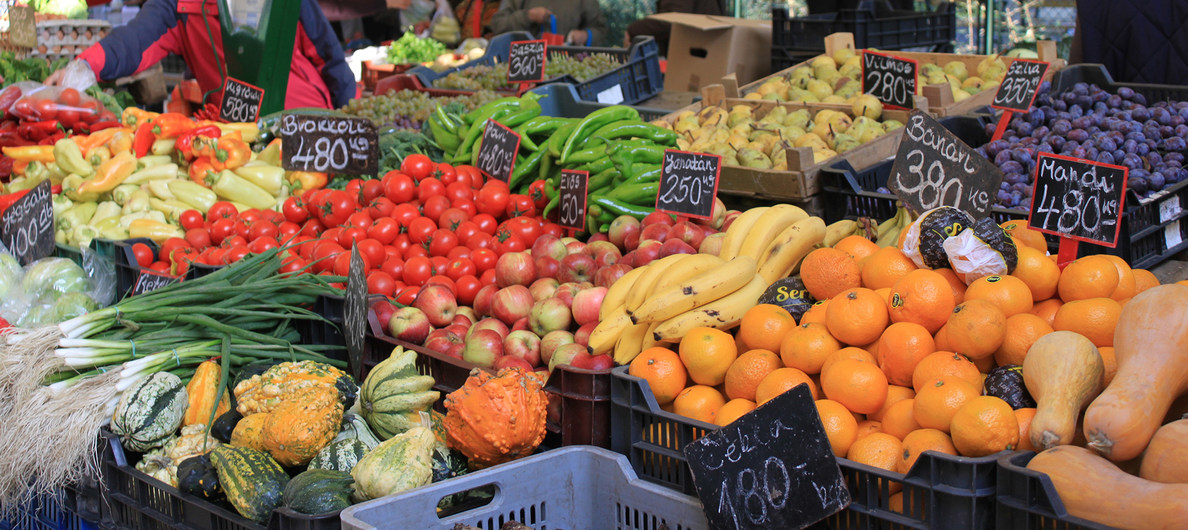
Photo caption and credit: FAO/G. Agostinucci
Reducing food waste and shifting towards more plant-rich diets is also a powerful climate mitigation tool, according to UNEP. Pictured here is a farmers' market in Hungary.
Support Our Journalism
We cannot do without you.. your contribution supports unbiased journalism
IBNS is not driven by any ism- not wokeism, not racism, not skewed secularism, not hyper right-wing or left liberal ideals, nor by any hardline religious beliefs or hyper nationalism. We want to serve you good old objective news, as they are. We do not judge or preach. We let people decide for themselves. We only try to present factual and well-sourced news.
Support objective journalism for a small contribution.


