


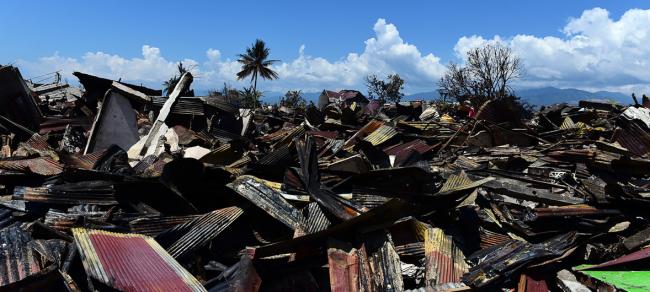
Disasters: UN report shows climate change causing ‘dramatic rise’ in economic losses
New York, Oct 11 (IBNS): Climate-related and geophysical disasters such as earthquakes and tsunamis have killed 1.3 million people over the last 20 years and left a further 4.4 billion injured, homeless or in need of emergency assistance, UN experts said on Wednesday.
The findings, published by the UN Office for Disaster Risk Reduction (UNISDR), also show that people in low- and middle-income countries are seven times more likely to die from natural disasters than those in developed nations.
“This puts a big emphasis on the need to…make sure that we curb greenhouse gas emissions,” said Ricardo Mena, UNISDR chief, in charge of implementing the Sendai Framework.
In terms of the impact of disasters on the global economy between 1998 and 2017, affected countries reported direct losses of $2.908 trillion. That’s more than twice what was lost in the previous two decades.Failing to do this, risks letting climate-related hazards get out of control, he told journalists in Geneva, before calling for greater investment in disaster risk-reduction measures, “so that we do not allow for countries to create new risk”.
Illustrating the growing threat from climate change, extreme weather events now account for 77 per cent of total economic losses, $2.245 trillion, the report notes.
This represents a “dramatic rise” of 151 per cent compared with losses reported between 1978 and 1997, which amounted to $895 billion.
Poorer countries most vulnerable, worst-hit
The increased vulnerability of poorer countries to disasters is illustrated by the fact that, in the last 20 years, only one officially high-income territory – the island of Puerto Rico – has featured in a league table of the top 10 economic losses as a percentage of gross domestic product (GDP).
Last September, devastation in the US-dependency caused by Hurricane Maria contributed to overall losses since 1998, of more than $71 billion; the equivalent of 12.2 per cent of Puerto Rico’s GDP.
Apart from Cuba, which is classified as an upper-middle income country in the 20-year review, the other top 10 worst-hit nations, as a percentage of their output, are all lower-income.
Haiti – where a deadly 5.9 magnitude earthquake struck the north-west of the island just four days ago – recorded the highest losses, at 17.5 per cent of GDP.
In terms of fatalities from disasters, the report indicates that more than 747,000 people – 56 per cent of the total - died in the last two decades during major seismic events, a total of 563 earthquakes and related tsunamis.
Overall, however, more than 90 per cent of all disasters in the last 20 years were in fact floods, storms, droughts and other extreme weather events.
Heatwaves are next climate change 'explosion'
Heatwaves are an increasing global threat for which solutions need to be found in the next five to 10 years, warned report co-author Professor Debarati Guha, from the Institute of Health and Society (IRSS), part of the Université Catholique de Louvain (UCL).
“The next one that is going to hit us with an explosion is heatwaves,” she said. “It’s going to be both in poor countries, remember, human beings have a limit, a thermal resistance limit…it is also going to be a huge problem in the wealthier countries.”
“We emphasize the need to reduce existing risk to strengthen the resilience of people and nations. Otherwise the success of the Sustainable Development Goals (SDGs) is going to be a very elusive target”, UNISDR’s Ricardo Mena said.
UNICEF/Arimacs Wilander
Support Our Journalism
We cannot do without you.. your contribution supports unbiased journalism
IBNS is not driven by any ism- not wokeism, not racism, not skewed secularism, not hyper right-wing or left liberal ideals, nor by any hardline religious beliefs or hyper nationalism. We want to serve you good old objective news, as they are. We do not judge or preach. We let people decide for themselves. We only try to present factual and well-sourced news.
Support objective journalism for a small contribution.


