


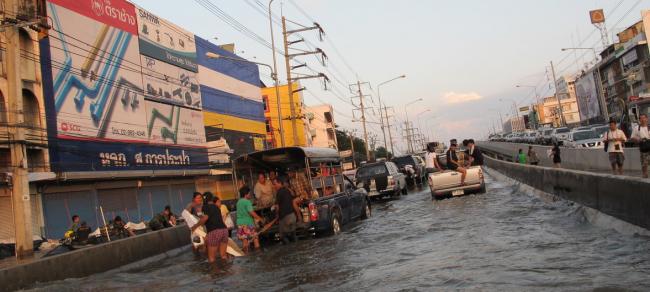
Disasters could cost Asia-Pacific region $160 billion per year by 2030, UN warns
New York, Apr 25 (IBNS): Economic losses to disasters in Asia and the Pacific could exceed $160 billion annually by 2030, the United Nations development arm in the region warned on Tuesday, urging greater innovation in disaster risk financing.
The need is all the more pressing given that only eight per cent of region’s losses are insured, said the UN Economic and Social Commission for Asia and the Pacific (ESCAP).
“The time for establishing solutions to these complex emerging challenges is now,” underlined Shamshad Akhtar, the Executive Secretary of ESCAP, speaking at an event on financing for disaster risk reduction in Asia-Pacific at the UN Headquarters, in New York.
The low insurance coverage has persisted in the region even though it has suffered nearly $1.3 trillion in losses over the last 50 years.
The result is that individuals, businesses and Governments are left to bear the staggering costs of natural calamities. And with extreme weather events increasing as the region’s cities become more crowded, the gap could widen.
“Business as usual is unsustainable […] policy makers and financial strategists in both the public and private sectors have to work together,” said the head of ESCAP.
She also highlighted the role ESCAP – which spans a geographic region from Turkey in the west to the tiny Pacific island of Kiribati in the east, and from Russia in the north to New Zealand in the south – could play.In her remarks, Akhtar outlined the opportunities offered by recent innovations such as catastrophe risk modelling, parametric insurance, a mix of traditional and global financial reinsurance, and concessional insurance.
“The provision of a regional platform for building capacity as well as mutual trust among countries is the key to successful sovereign risk pooling [and] ESCAP, whose primary mandate is regional cooperation, is well suited for this role,” said Akhtar.
Speaking alongside Akhtar, Mami Mizutori, Head of the UN Office for Disaster Risk Reduction (UNISDR), highlighted the importance of both disaster risk financing and resources to reduce disaster risk to ensure resilient and sustainable development.
“At present, we need both […] Let’s face it: when natural hazards hit, without these mechanisms, we cannot cope with the aftermath,” she said.
Mizutori, who is also the Special Representative of the UN Secretary-General for Disaster Risk Reduction, also highlighted the importance national strategies to strengthen resilience and mitigate natural hazard risks, a call made in the Sendai Framework for Disaster Risk Reduction.
Support Our Journalism
We cannot do without you.. your contribution supports unbiased journalism
IBNS is not driven by any ism- not wokeism, not racism, not skewed secularism, not hyper right-wing or left liberal ideals, nor by any hardline religious beliefs or hyper nationalism. We want to serve you good old objective news, as they are. We do not judge or preach. We let people decide for themselves. We only try to present factual and well-sourced news.
Support objective journalism for a small contribution.


