


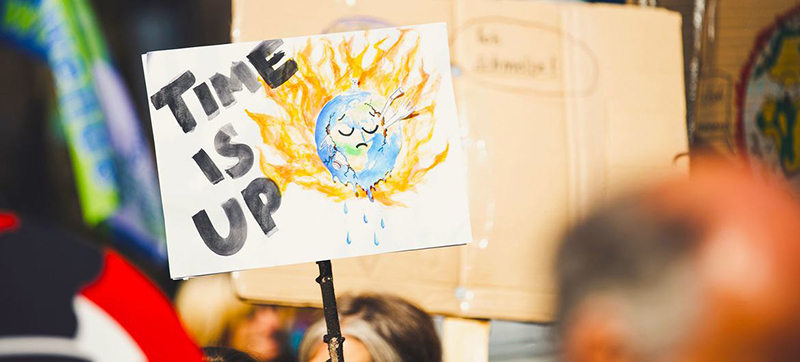
 Global Temperature
Climate: World getting ‘measurably closer’ to 1.5-degree threshold
New York: There is a 50:50 chance of average global temperature reaching 1.5 degrees Celcius above pre-industrial levels in the next five years, and the likelihood is increasing with time, according to a new report by the World Meteorological Organization (WMO), published on Tuesday in Geneva.
The Global Annual to Decadal Climate Update also reveals a 93 per cent likelihood of at least one year between 2022 to 2026 becoming the warmest on record, thus knocking 2016 from the top spot.
The chance of the five-year average for this period being higher than the last five years, 2017-2021, is also 93 per cent.
The 1.5 °C target is the goal of the Paris Agreement, which calls for countries to take concerted climate action to reduce greenhouse gas emissions in order to limit global warming.
Probability rising
“This study shows – with a high level of scientific skill – that we are getting measurably closer to temporarily reaching the lower target of the Paris Agreement on Climate Change,” said Petteri Taalas, the WMO Secretary-General.
“The 1.5°C figure is not some random statistic”, he added, but “rather an indicator of the point at which climate impacts will become increasingly harmful for people and indeed the entire planet.”
The chance of temporarily exceeding the 1.5°C threshold has risen steadily since 2015, according to the report, which was produced by the United Kingdom’s Met Office, the WMO lead centre for climate update predictions.
Back then, it was close to zero, but the probability increased to 10 per cent over the past five years, and to nearly 50 per cent for the period from 2022-2026.
Wide-ranging impacts
Mr. Taalas warned that as long as countries continue to emit greenhouse gases, temperatures will continue to rise.
“And alongside that, our oceans will continue to become warmer and more acidic, sea ice and glaciers will continue to melt, sea level will continue to rise and our weather will become more extreme. Arctic warming is disproportionately high and what happens in the Arctic affects all of us,” he said.
The Paris Agreement outlines long-term goals that guide governments towards limiting the global temperature increase to well below 2 °C, while pursuing efforts to limit the increase even further to 1.5 °C.
‘Edging ever closer’
The UN’s Intergovernmental Panel on Climate Change further states that climate-related risks are higher for global warming of 1.5 °C than at present, but lower than at 2 °C.
“Our latest climate predictions show that continued global temperature rise will continue, with an even chance that one of the years between 2022 and 2026 will exceed 1.5 °C above pre-industrial levels,” said Dr. Leon Hermanson of the UK Met Office, who led the report.
“A single year of exceedance above 1.5 °C does not mean we have breached the iconic threshold of the Paris Agreement, but it does reveal that we are edging ever closer to a situation where 1.5 °C could be exceeded for an extended period.”
Last year, the global average temperature was 1.1 °C above the pre-industrial baseline, according to the provisional WMO report on the State of the Global Climate. The final report for 2021 will be released on 18 May.
WMO said back-to-back La Niña events at the start and end of 2021 had a cooling effect on global temperatures. However, this is only temporary and does not reverse the long-term global warming trend.
Any development of an El Niño event would immediately fuel temperatures, the agency said, as happened in 2016, the warmest year on record.
Support Our Journalism
We cannot do without you.. your contribution supports unbiased journalism
IBNS is not driven by any ism- not wokeism, not racism, not skewed secularism, not hyper right-wing or left liberal ideals, nor by any hardline religious beliefs or hyper nationalism. We want to serve you good old objective news, as they are. We do not judge or preach. We let people decide for themselves. We only try to present factual and well-sourced news.
Support objective journalism for a small contribution.


