


 Manoj Sinha
Climate change has affected water sources in J&K: LG Manoj Sinha
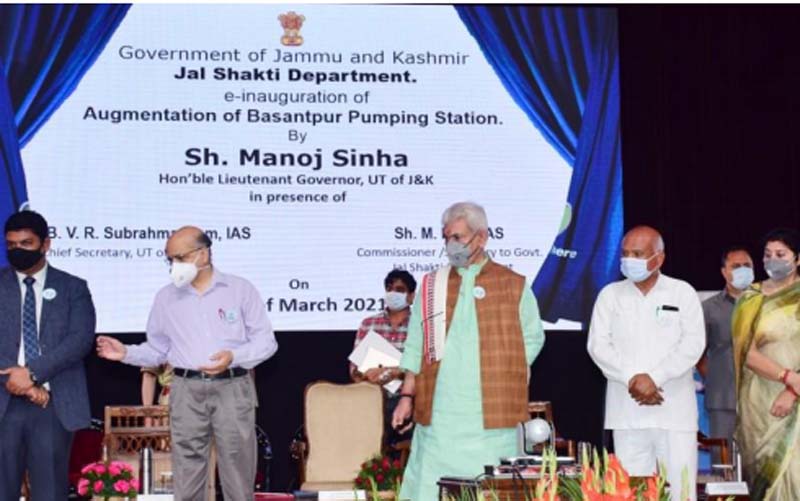
Srinagar: Lt Governor Manoj Sinha today said that climate change has reduced the size of glaciers leading to fast depletion of water resources in many districts of J&K.
Speaking at a function organized here, the Lt Governor said: “Out of 208 hydrograph stations which were monitored, the water level in 171 water wells has been decreasing which is a cause of concern and we need to work on their preservation.”
He said there are only 37 such wells in which the water level has increased in Jammu division.
In many areas of Jammu, Kathua, Samba and Udhampur districts of Jammu region, he said, the water level has come down and “we have to work to increase the water level in such areas”.
He emphasized on the need to remove all obstacles coming in the way of water resource conservation.
“I believe that the old techniques to preserve and protect water resources are more effective. More efforts should be made jointly towards the protection of the water resources,” he said.
He said for years majority of the water bodies including ponds have been ignored, while quoting a report of Survey of India in 1911 on Wuler Lake in Kashmir Valley.
“As per the report, Asia’s largest freshwater lake today is confined to 75.82 sq kms from 91.29 sq kms open area. I have discussed one, but the condition of other water bodies is similar,” he said.
He said that as per a 1966 survey in Baramulla district there were 163 lakes and water bodies and now, they are reduced 124; in Kupwara district, there were 111 lakes and water bodies which have now reduced to 88.
In Udhampur district of Jammu region, he said, there were 26 lakes and water bodies, and now, they are reduced to only 19.
“So due to the climate change, the glaciers size has reduced due to which the water resources in many districts have been depleting fast.”
However, he said, from several years, the administration has made efforts for the preservation of water resources and in many districts the resources have also increased like in Doda in Jammu region, and other parts of Kashmir Valley.
In 1966, he said, Doda district had 13 water bodies, and now they have increased to 88m whereas in Srinagar, that time there were 52 water bodies and now they have increased to 74. In Anantnag, he said, the 1966 survey shows that there were 88 water bodies and now they have increased to 98.
Support Our Journalism
We cannot do without you.. your contribution supports unbiased journalism
IBNS is not driven by any ism- not wokeism, not racism, not skewed secularism, not hyper right-wing or left liberal ideals, nor by any hardline religious beliefs or hyper nationalism. We want to serve you good old objective news, as they are. We do not judge or preach. We let people decide for themselves. We only try to present factual and well-sourced news.
Support objective journalism for a small contribution.


