

UN official urges 'bold, challenging' talks during forum on development cooperation
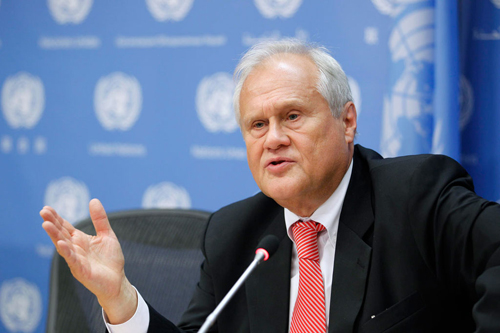
Opening the 2014 session of the Development Cooperation Forum (DCF), which will focus on the theme ,“Bringing the future of development cooperation to post 2015”, Martin Sajdik called on participating representatives and experts to be “bold, challenging and focused” during the Forum’s two-day meeting.
He called the Council a platform that brings everything together for a unified dialogue on sustainable and inclusive development. The 54-member body is the principle UN organ for coordination and policy formulation on all three pillars of sustainable development: economic, social and environmental.
Meeting every two years, the Forum reviews trends in international development cooperation, promotes greater coherence among the development activities of different development partners and helps to promote policy integration and to strengthen the normative and operational link in the work of the UN.
The Forum gives voice to a wide range of stakeholders, including developing and developed countries as well as civil society, parliamentarians, audit institutions, local and regional governments, philanthropic organizations and the private sector. The body also encourages participatory multi-stakeholder dialogue on major development cooperation issues.
In his remarks on the Forum’s theme, Mr. Sajdik stressed the need to find solutions to the multiple dimensions of poverty that are inclusive of all development actors. That must occur through open dialogue, sharing of knowledge and experience, guided by analysis of recent trends and progress in development cooperation. Throughout the two-year preparatory process for the 2014 DCF, the Council has advanced an inclusive, global approach to development cooperation that fits both the scale and scope of action required for the post-2015 era.
Working towards the UN’s 0.7 per cent official development assistance (ODA) target remains critical, he told the Forum. Yet, even if met, ODA commitments would still fall far short of what will be needed to support implementation of the global development agenda.
Other sources of financing must be explored, he urged members. Domestic resource mobilization, a renewed global partnership for development and the participation of the business sector are essential. A renewed partnership for development must bring together the Monterrey [2002 International Conference on Financing for Development] and the Rio+20 [United Nations Conference on Sustainable Development] tracks.
Looking ahead to the post-2015 era, Mr. Sajdik said the Forum will be well-positioned to review the development cooperation aspects of a renewed global partnership for development and to continue reviewing national mutual accountability and transparency.
The next two days are the last occasion to look back on the role of various stakeholders in development cooperation before the Open Working Group on Sustainable Development Goals and the Expert Committee on Sustainable Development Financing will each conclude their work, he said.
Ambassador Martin Sajdik of Austria, President of the Economic and Social Council (ECOSOC) for 2014. UN Photo/Paulo Filgueiras
Support Our Journalism
We cannot do without you.. your contribution supports unbiased journalism
IBNS is not driven by any ism- not wokeism, not racism, not skewed secularism, not hyper right-wing or left liberal ideals, nor by any hardline religious beliefs or hyper nationalism. We want to serve you good old objective news, as they are. We do not judge or preach. We let people decide for themselves. We only try to present factual and well-sourced news.
Support objective journalism for a small contribution.