 Tata Group
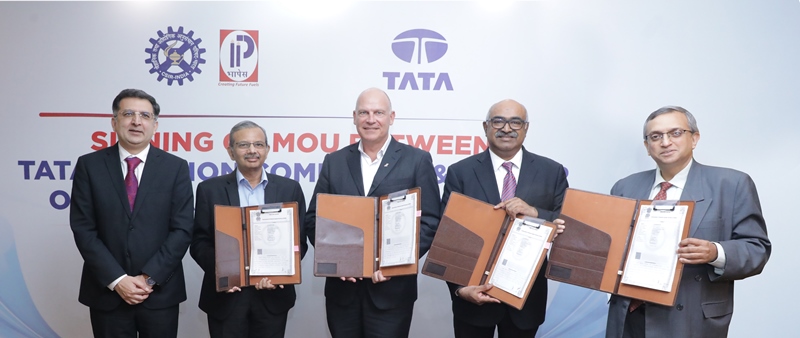
Tata Group airlines & CSIR-IIP ink MoU to deploy SAFs
New Delhi/IBNS: The Tata Group airlines– Air India, AirAsia India and Vistara (Tata SIA Airlines)- signed a Memorandum of Understanding (MoU) with the Council of Scientific and Industrial Research – Indian Institute of Petroleum Thursday to to collaborate on the research, development and deployment of sustainable aviation fuels (SAFs).
This move will give a major push towards achieving the net-zero carbon emission goal of International Air Transport Association (IATA) by 2050, lining with the objectives of the Paris agreement to limit global warming to 1.5°C.
The focus of the MoU is on the exploration of Single Reactor HEFA Technology for Drop-in liquid Sustainable Aviation and Automotive Fuel (DILSAAF), according to a media release.
The impact of continued use of petroleum-derived fuel for aviation is considerable with greenhouse gas and carbon emissions being of significant concern globally.
As per IATA, the aviation industry’s net-zero carbon emissions target is focused on delivering maximum reduction in emissions at its source, along with the adoption of sustainable aviation fuels (SAFs), contributing around 65 percent of the reduction in discharge.
The 'drop in fuel' or SAFs are made from sustainable resources, such as forestry, agricultural waste & used cooking oil.
It can be blended with fossil jet fuel to reduce emissions.
In addition to the use of SAFs, innovative new propulsion technologies, and other efficiency improvements will play a significant role in reducing carbon emissions.
Support Our Journalism
We cannot do without you.. your contribution supports unbiased journalism
IBNS is not driven by any ism- not wokeism, not racism, not skewed secularism, not hyper right-wing or left liberal ideals, nor by any hardline religious beliefs or hyper nationalism. We want to serve you good old objective news, as they are. We do not judge or preach. We let people decide for themselves. We only try to present factual and well-sourced news.
Support objective journalism for a small contribution.