 FTA
FTA
Strategic playbook: India’s 'mother of all deals' outmanoeuvres US tariffs and counters China’s shadow
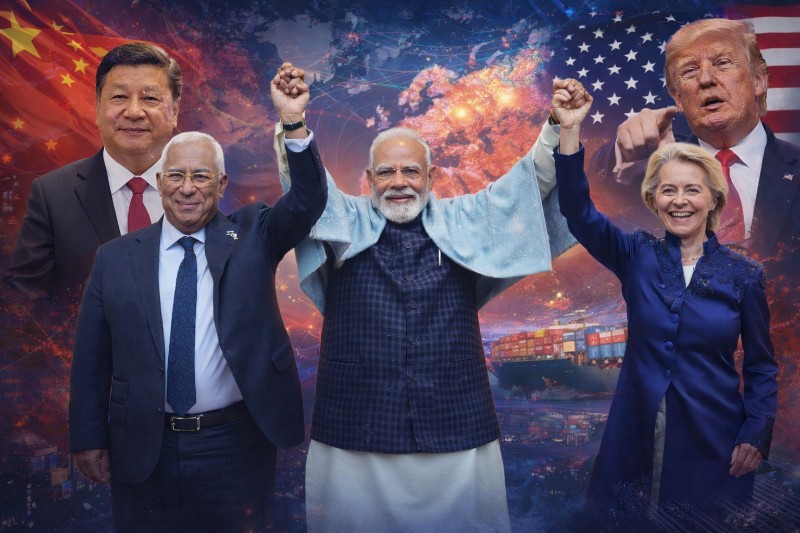
India and the European Union (EU) on Tuesday (January 27) sealed a long-anticipated Free Trade Agreement (FTA), heralded on both continents as a transformative pact linking two major economic powers comprising roughly 25% of global GDP and one-third of world trade.
Described by EU leaders as the “mother of all deals”, the accord eliminates or substantially reduces tariffs on an exceptionally broad range of goods and services, and deepens commercial, strategic and people-to-people ties.
This breakthrough comes at a time of heightened global trade turbulence, marked by aggressive protectionist policies in Washington and intensifying economic competition with China.
India’s FTA with the EU now stands as a defining moment in the country’s strategy to diversify markets and strengthen its role as a stabilising global partner.
A strategic response to US tariff pressure
India’s negotiations with the United States have been slow and strained.
Washington, under President Donald Trump, has imposed steep tariffs—reportedly up to 25% or more—on Indian exports in response to New Delhi’s continued purchases of Russian crude oil.
U.S. Treasury Secretary Scott Bessent highlighted this dynamic, noting that while the U.S. has slapped tariffs on India over Russian oil imports, the EU proceeded with its trade deal with India, implicitly challenging Washington’s stance.
Scott Bessent is already showing signs of a meltdown in reaction to the European Union’s FTA with India. The Trump administration will find it a lot harder to justify its policy towards India. The whole thing is backfiring. pic.twitter.com/AgTq8nNwXs
— Shubhangi Sharma (@ItsShubhangi) January 26, 2026
Officials in New Delhi have countered these criticisms vigorously, characterising the tariff measures as unjustified and double-standarded—pointing out that both the U.S. and EU maintain significant trade with Russia even while criticising India’s energy choices.
The Indian Ministry of External Affairs underscored that energy procurement decisions were shaped by market conditions and global supply disruptions, not political alignment.
Kirti Vardhan Singh, India’s Minister of State for External Affairs, emphasised India’s economic resilience, stating that U.S. tariffs “won’t hurt India much” and highlighting the country’s diversified trade strategies.
Rebalancing markets: A hedge against protectionism
Analysts see the EU agreement as a decisive hedge against unpredictable U.S. trade policy.
Unlike the tariff-first approach in Washington, India’s diplomacy has leaned on comprehensive negotiated frameworks that strengthen integration with multiple partners.
The India–EU FTA offers expanded access for Indian exports such as textiles, leather goods and marine products, while gradually opening Indian markets to European cars and wine—moves that hold promise of boosting trade volumes and diversifying export destinations.
European Council President António Costa framed the deal as a collective message against tariffs and protectionism.
He stressed that a multipolar, rules-based trading order benefits both India and Europe—underscoring that the pact sends a geopolitical signal at a time when some global powers have turned toward tariff-driven trade barriers.
China’s presence in the periphery
While the India-EU FTA directly engages two major economies, it also resonates in a broader context where China’s influence looms large.
Beijing’s role in global supply chains and its sustained trade expansion across Asia, Africa and Europe create competitive pressures for all major economies, including India.
India’s deeper integration with the EU offers an alternative corridor of growth and trade cooperation that can counterbalance China-centric supply networks.
European policymakers, mindful of economic dependencies on China, welcomed closer ties with India as a diversification strategy—both commercially and strategically.
Expert analysis suggests that this is part of a broader recalibration in which Western powers seek reliable partners that both share democratic norms and can act as counterweights to China’s expansive trade footprint.
Signalling geopolitical maturity
The India-EU trade agreement transcends conventional economics.
It marks India’s evolution from a developing market to a central actor in shaping global trade norms.
By binding India more deeply with the EU—while Washington’s tariff strategy remains uncertain—New Delhi is signalling that strategic autonomy and diversified partnerships are essential in a fragmented world order.
Observers have noted that countries frustrated by tariff volatility in Washington are watching India’s approach closely, with some pivoting toward agreements that promise stability and long-term growth.
The India-EU pact not only mitigates the impact of U.S. tariffs but also positions India as a linchpin in a more balanced and resilient global trade architecture.
Support Our Journalism
We cannot do without you.. your contribution supports unbiased journalism
IBNS is not driven by any ism- not wokeism, not racism, not skewed secularism, not hyper right-wing or left liberal ideals, nor by any hardline religious beliefs or hyper nationalism. We want to serve you good old objective news, as they are. We do not judge or preach. We let people decide for themselves. We only try to present factual and well-sourced news.
Support objective journalism for a small contribution.