Reforms are not about a few big bang ideas: Arun Jaitley
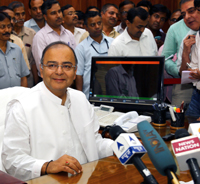
Speaking at the inaugural session of the India Economic Summit organized by the World Economic Forum and the Confederation of Indian Industry in New Delhi, the Minister of Finance, Corporate Affairs and Defence, Arun Jaitley said he was satisfied that his government has begun the long journey of reforms.
Reforms are not about a few big bang ideas, he said, although a single bad step can damage the economy.
He believed that the ground results of the steps taken by his government will start reflecting soon.
Jaitley was interacting with Klaus Schwab, Founder and Executive Chairman, World Economic Forum.
Asked how the new government planned to tackle the systemic failure caused by corruption, the Minister said that the government’s actions had been aimed at eliminating discretion.
He gave the example of the coal ordinance by which rules had been set for allocation of mining licenses, first to the state sector and then to actual users through e-auction.
Commercial mining by private investors is also envisaged. He said that similar reforms are being planned for other minerals.
With regard to the issue of privatization and greater access to foreign investors, he said that currently the government is following the approach of divestment rather than outright privatization.
However, he would be open to loss-making public sector units being sold off.
As far as access to foreign investors is concerned, the government would follow a sectoral approach.
Most recently, the limit on foreign investment had been raised to 49% in the defence sector while the Insurance Bill was awaiting passage in Parliament.
Railways and real estate are two other sectors where foreign investment had been eased.
Answering a question on how he proposed to ease the bottlenecks created by the land acquisition bill introduced by the previous government, he said that he would focus on easing the procedural complications.
He had no quarrel with the increase in compensation proposed by the law. In particular, he would need to deal with the provision that disallows private schools, hospitals and hotels on land acquired by the government. Such a provision would make it difficult to build smart cities being proposed by the government.
He also explained in detail India’s position on trade facilitation, saying that there is no ideological opposition on this issue.
Even without a commitment to WTO, India would unilaterally support moves to facilitate trade. However, a solution is required to the dispute regarding holding of food stocks by India.
The peace clause should not be phased out till this dispute is settled.
Replying to a question on whether India’s subsidies are sustainable, he said that the government is already rationalizing some subsidies.
However, they cannot be eliminated in a poor country like India.
He said that it is far more challenging to implement reforms in a developing society, as public opinion cannot be confronted.
For example, while some steps had been taken to reform labour laws, others in the political system needed to be convinced in order to move further in that direction. He reiterated his view that reforms are the art of the possible.
He concluded with a discussion on how India’s relations with Pakistan had deteriorated on account of actions taken by Pakistan.
While India had shown its willingness to normalize relations with its neighbor, Pakistan had created an unaffordable cost for itself by worsening the border situation.
The Minister was earlier welcomed by Viraj Mehta, Director, Head of India and South Asia, World Economic Forum and by Chandrajit Banerjee, Director General, Confederation of Indian Industry.
Support Our Journalism
We cannot do without you.. your contribution supports unbiased journalism
IBNS is not driven by any ism- not wokeism, not racism, not skewed secularism, not hyper right-wing or left liberal ideals, nor by any hardline religious beliefs or hyper nationalism. We want to serve you good old objective news, as they are. We do not judge or preach. We let people decide for themselves. We only try to present factual and well-sourced news.
Support objective journalism for a small contribution.