At UN Economic and Social Council, ministers commit to 'people-centred' post-2015 development agenda
“We, the Ministers, are committed to establishing a strong, universal, ambitious, inclusive and people-centred post-2015 development agenda that will build on the foundations laid and experiences gained by the Millennium Development Goals, complete the unfinished business and respond to new challenges,” reads the declaration which was adopted by ECOSOC at the opening of its Annual Ministerial Review.
Since Monday, the Council has been holding the Ministerial portion of the High-level Political Forum (HLPF) on sustainable development, under the auspices of ECOSOC.
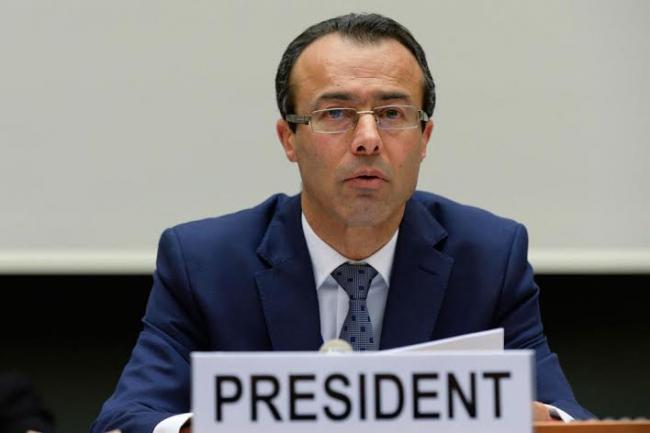
Speaking on the behalf of the ECOSOC President, Martin Sajdik, Vice President Mohamed Khaled Khiari reminded delegations that a smooth transition from the MDGs to a transformative post-2015 development agenda will be “critical” for the future of global development.
But what does that mean for citizens around the world? What is their connection to the MDGs, or will be their relationship to this new agenda? Khiari asked.
“The answer is simple: they mean change – tangible and real change that must improve people's wellbeing and that of our planet.”
It is those conditions, the Council Vice-President continued, that Member States cannot lose sight of the importance of putting in place the enabling environment for people to thrive, with sound policies, strong institutions and a respect for the rule of law.
“Good leadership and resilient populations create conditions that enable change, transforming the lives of individuals and their communities across the globe.”
The emerging post-2015 development agenda, including a proposed set of sustainable development goals (SDGs) that are to be adopted at a summit at UN Headquarters in September, strive to reflect lessons learned from the largely anti-poverty based MDGs, build on the successes and put all countries, together, firmly on track towards a more prosperous, sustainable and equitable world.
The next two days of the Annual Ministerial Review will be marked by an intense discussion on how to successfully transition from the MDG to the SDG era, Khiari explained. For him, ECOSOC is well placed to provide policy guidance on how global challenges can be addressed and how sound policies can be translated into “real life results.”
The High-level segment of ECOSOC is a key venue for the global dialogue on sustainable development, he stressed, adding that he is encouraged that this year's Review will include four National Voluntary Presentations, by the Governments of Kyrgyzstan, Mongolia, the Philippines and Zambia.
It will also include a “mandated review” of implementation of the Programme of Action for Least Developed Countries for the Decade 2011-2020. There will be a special session dedicated to this review, and the opportunities and challenges of those countries face in the transition will also be addressed in several other sessions, Khiari stressed.
“Let us unite to identify the most innovative paths forward for managing the transition from the MDGs to the post-2015 development agenda, keeping in mind who we have committed to: the people of this world, each and every one of them, and planet Earth itself. This period of transition is a vital part of what is to come. You may say: The future is now.”
UN Photo/Jean-Marc Ferré
Support Our Journalism
We cannot do without you.. your contribution supports unbiased journalism
IBNS is not driven by any ism- not wokeism, not racism, not skewed secularism, not hyper right-wing or left liberal ideals, nor by any hardline religious beliefs or hyper nationalism. We want to serve you good old objective news, as they are. We do not judge or preach. We let people decide for themselves. We only try to present factual and well-sourced news.
Support objective journalism for a small contribution.