ADDIS: International Monetary Fund boosts efforts to help countries finance development
The measures are intended to better support countries in their pursuit of the set of Sustainable Development Goals (SDGs), which world leaders are expected to adopt in New York in September and which focus on ending poverty, transforming lives and protecting the planet.
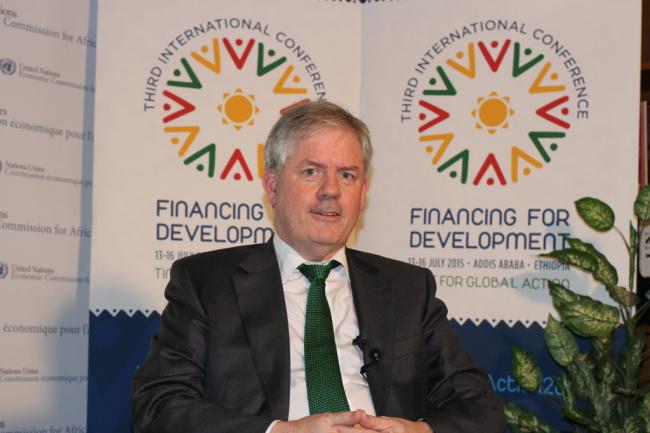
The Deputy Director of the IMF's Strategic Policy and Review Department, Sean Nolan, said that ahead of the Third International Conference on Financing for Development, the Fund took a look at its operations “through the lens of FFD” to see how it could improve its work.
It has decided to expand access to all of its concessional facilities by 50 per cent, which means making more money available for eligible low-income countries. “Working the numbers, we felt we could lend more to lower-income countries,” Nolan said in an interview with the UN News Service.
In addition to this, the Fund set the interest rate at zero for all loans extended under the Rapid Credit Facility, which is targeted at countries hit by natural disasters and fragile/post-conflict States.
Another way for the Fund to “deliver more value,” Nolan said, is increased policy advice, technical assistance and capacity building to help countries boost economic resilience. This includes doing more to assist countries with domestic resource mobilization, or tax collection, a critical source of revenue for governments.
“There's only so much amount of aid countries can rely on. Indeed, often you can't rely on aid in the sense of relying on certain amounts every single year… it goes up, it goes down… governments fall in and out of love with the donors… so it's not so reliable,” said Nolan.
“At the end of the day, a State operates on the basis of its own revenue collection. And a developmentally-oriented State, a State that actually wants to promote development through infrastructure, health, education spending, needs to raise most of the money itself.”
He added that raising revenue does not necessarily mean going into the rural areas and heavily taxing people. “It actually means taxing the better off in the society and also taxing companies, both domestic and foreign, more effectively.”
Tax rates, he noted, are very low in many low-income countries, in some cases under 15 per cent of gross domestic product (GDP). This could easily be increased by a series of reforms, as well as by better structuring of taxation in the extractive industries and greater attention to the transfer of money out of the country.
This includes the profits of companies that are being transferred abroad. “If they're legal transfers, that's fine. But if the tax code is weak or inadequate, then the country is losing revenue to foreign companies. They should be doing a better job of capturing it.”
Ahead of the Addis Ababa Conference, the IMF and the World Bank launched a new initiative to help developing countries strengthen their tax systems, with the belief that raising additional revenues will help these countries to fill financing gaps and to promote development.
Among the other sustainable development-related issues the Fund intends to focus more on are energy pricing, environmental tax issues and carbon pricing schemes, as well as helping countries build up their infrastructure.
Headquartered in Washington, D.C. and comprised of 188 countries, the IMF's mission is to ensure the stability of the international monetary system in three ways: keeping track of the global economy and the economies of member countries; lending to countries with balance of payments difficulties; and giving practical help to members.
UN Photo/P. Lecomte
Support Our Journalism
We cannot do without you.. your contribution supports unbiased journalism
IBNS is not driven by any ism- not wokeism, not racism, not skewed secularism, not hyper right-wing or left liberal ideals, nor by any hardline religious beliefs or hyper nationalism. We want to serve you good old objective news, as they are. We do not judge or preach. We let people decide for themselves. We only try to present factual and well-sourced news.
Support objective journalism for a small contribution.