

 Taslima Nasreen
'With her death…': Taslima Nasreen revisits book bans, free speech battle under Khaleda Zia after ex-Bangladesh PM's death
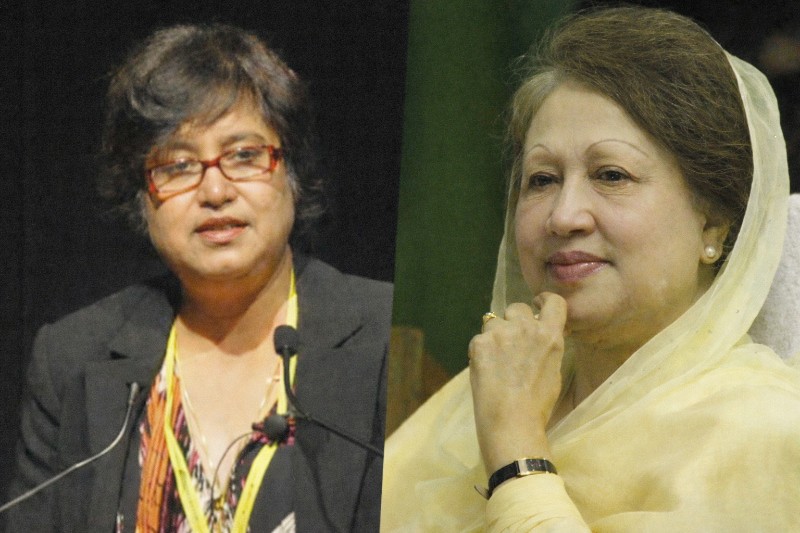
New Delhi/IBNS: Exiled Bangladeshi author Taslima Nasreen has reignited a long-running debate on censorship and freedom of expression following the death of former Bangladesh Prime Minister Khaleda Zia.
Nasreen, whose works were repeatedly banned during Zia’s tenure, used social media to reflect on what she described as years of persecution, state-backed censorship and forced exile.
Taking to X on Tuesday, Nasreen recalled how successive governments led by Khaleda Zia had targeted her writings, accusing the former prime minister of siding with religious fundamentalists.
She alleged that Zia’s administration filed cases against her for “hurting religious sentiments,” issued arrest warrants and ultimately ensured that she was expelled from Bangladesh.
“She unjustly expelled me from my own country,” Nasreen wrote, adding that she was denied the right to return home throughout Zia’s rule. Her remarks came hours after news broke that Khaleda Zia had died following a prolonged illness.
Khaleda Zia has passed away. She was 80 years old. From a housewife she became a party chief, and served as the country’s prime minister for ten years. She lived a successful life—a long life. Sheikh Hasina kept her in jail for two years; apart from that period, I don’t think she…
— taslima nasreen (@taslimanasreen) December 30, 2025
In a sharply worded post, Nasreen questioned whether Zia’s death would finally lead to the lifting of bans imposed on books critical of religious extremism and political violence.
“With her death, will the bans on the books she banned be lifted? They should be lifted,” she stated, listing several of her works that were prohibited during different phases of Zia’s leadership.
Nasreen specifically cited Lajja (Shame), banned in 1993, Utal Hawa in 2002, Ka in 2003, and Those Dark Days in 2004.
She pointed out that while Zia was alive, no effort was made to reverse these restrictions, despite repeated appeals from writers and free speech advocates.
“If her death now ends up protecting freedom of expression, so be it,” Nasreen declared, underscoring what she described as a lifelong struggle against censorship in Bangladesh.
Among the banned works, Lajja remains the most internationally recognised.
The novel documented violence against Hindus in Bangladesh following the demolition of the Babri Masjid in India in 1992.
Although the book was initially banned in 1993 and briefly allowed later, renewed protests from religious groups led to its permanent prohibition.
The clampdown on Nasreen’s writings intensified in the mid-1990s.
In May 1994, Bangladeshi authorities banned several more of her books, including Fera (Divorce), Phera (Return) and Nirbasan (Exile), citing threats to public order and allegations of hurting religious sentiments.
These bans followed a series of death threats and violent protests by fundamentalist groups aligned with the Bangladesh Nationalist Party (BNP), then led by Khaleda Zia.
Facing mounting threats, Nasreen fled Bangladesh in 1994, first seeking refuge in Sweden.
A decade later, she relocated to India, where she continues to live in exile.
Khaleda Zia, one of Bangladesh’s most influential political figures, died early Tuesday at the age of 80.
According to national dailies, she had been undergoing treatment for serious infections affecting her heart and lungs and was also suffering from pneumonia.
Although Zia had been out of power since 2006 and spent several years either imprisoned or under house arrest, her political influence endured.
Zia's centre-right BNP has retained a strong support base and is widely seen as the frontrunner in Bangladesh’s next parliamentary elections scheduled for February.
The political transition gained momentum last week with the return of Zia’s son, Tarique Rahman, from nearly 17 years in self-imposed exile.
The 60-year-old BNP acting chairman is considered a strong contender for the prime minister’s post, further elevating the significance of debates around the party’s legacy.
Nasreen’s remarks have reopened old wounds in Bangladesh’s cultural and political discourse, bringing renewed attention to the unresolved tension between political power, religious influence and freedom of expression.
Support Our Journalism
We cannot do without you.. your contribution supports unbiased journalism
IBNS is not driven by any ism- not wokeism, not racism, not skewed secularism, not hyper right-wing or left liberal ideals, nor by any hardline religious beliefs or hyper nationalism. We want to serve you good old objective news, as they are. We do not judge or preach. We let people decide for themselves. We only try to present factual and well-sourced news.
Support objective journalism for a small contribution.