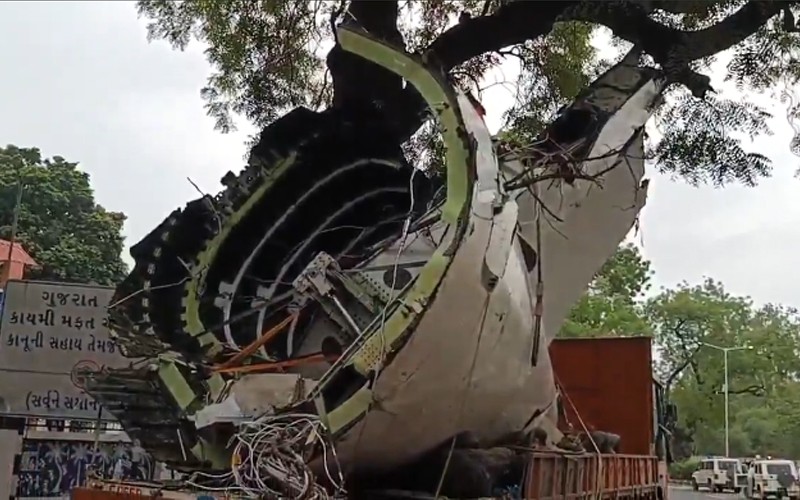
Tail section under lens in Air India AI-171 crash probe: Investigators suspect electrical fault
New Delhi: Nearly a month after Air India flight AI-171 crashed seconds after take-off from Ahmedabad, investigators are focusing on the aircraft’s tail section as a potential origin of the malfunction that led to the fatal accident, the Indian Express has reported.
The Boeing aircraft, which was airborne for just 26 seconds on June 12, crashed in a fireball, killing everyone except one passenger on board.
Investigators say the aircraft’s empennage — or tail assembly — has provided vital clues in the ongoing probe.
While the tail section broke off during impact, it escaped the worst of the post-crash fire.
According to the report, early inspections indicate signs of a localised electrical fire in rear components, which have now been moved to a facility in Ahmedabad for forensic testing.
Also Read: FIP slams WSJ over Air India AI 171 crash report, calls claims on pilot actions unfounded
“The tail section may hold answers to whether an electrical fault contributed to the crash during lift-off,” a senior investigator was quoted as saying.
The aircraft’s aft Enhanced Airborne Flight Recorder — commonly called the rear black box — was recovered from the rooftop of the BJ Medical College hostel mess the day after the crash.
However, the device had suffered extensive internal damage, and even its memory card was heavily compromised, according to preliminary findings by the Aircraft Accident Investigation Bureau (AAIB).
In contrast, the forward black box, retrieved later from the burned cockpit debris, was intact enough to yield crucial data.
Investigators were able to extract approximately 49 hours of flight data, including a two-hour cockpit audio recording from the final flight.
Although both black boxes are built to withstand extreme impact and heat, the aft recorder depends on the aircraft’s main electrical system for power.
This has raised concerns about a possible mid-air electrical failure.
The forward unit, powered by an independent battery, continued to function and record data.
Investigators are now closely examining tail-mounted systems, including the Auxiliary Power Unit (APU), stabiliser transducers, and rudder mechanisms, the report says.
While the official cause remains under investigation, the probe’s current direction suggests an electrical fault in the tail section may have triggered a chain reaction of failures in vital systems.
The AAIB’s next report is expected to explore these findings further, including whether any known technical issues had been overlooked or inadequately addressed before the aircraft was cleared to fly.
Support Our Journalism
We cannot do without you.. your contribution supports unbiased journalism
IBNS is not driven by any ism- not wokeism, not racism, not skewed secularism, not hyper right-wing or left liberal ideals, nor by any hardline religious beliefs or hyper nationalism. We want to serve you good old objective news, as they are. We do not judge or preach. We let people decide for themselves. We only try to present factual and well-sourced news.
Support objective journalism for a small contribution.