 J&K
J&K
Seven years after Article 370: How railways, roads, investment are redrawing Jammu and Kashmir
Seven years after the abrogation of Article 370, Jammu and Kashmir’s public narrative is increasingly being shaped by a different set of markers: railways, tunnels, highways, airports, tourism, investment, hydropower, agriculture and jobs.
The change is not represented by one project or a single economic number. Instead, it is emerging through the gradual convergence of infrastructure, connectivity and economic activity across the Union Territory.
The Kashmir Valley’s integration with the national railway network, expansion of road and tunnel infrastructure, rising tourist numbers, new investment, growing power-sector potential and government-backed entrepreneurship programmes are together creating a development framework that looks markedly different from the one dominated for decades by questions of conflict, security and political uncertainty.
The latest economic indicators provide another measure of this shift.
According to the J&K Economic Survey 2025-26, real Gross State Domestic Product (GSDP) is estimated to grow by 5.82 percent in 2025-26, while nominal GSDP is projected at around ₹2.86 lakh crore.
The Survey estimates per capita income at ₹1,68,243 and identifies services as the largest contributor to Gross State Value Added, accounting for 61.02 percent.
Broader economic base takes shape
The emerging economic story is not confined to services.
Agriculture and allied activities remain central to livelihoods, while horticulture, tourism, manufacturing, construction and energy are creating additional avenues for economic activity.
The Economic Survey estimates that the primary sector contributed 20.45 percent and the secondary sector 18.52 percent to Gross State Value Added in 2025-26.
The tertiary sector accounted for 61.02 percent.
Agriculture and horticulture continue to occupy an important place in this structure.
High-density plantations, improved market access and the expansion of Farmer Producer Organisations are helping move parts of the rural economy towards more organised and commercially oriented production.
The government’s Holistic Agriculture Development Plan is another major component.
The plan envisages an investment of ₹5,013 crore across 29 projects over five years, with the stated objectives of improving agricultural productivity, strengthening value chains and generating employment.
The significance of this diversification lies in the emergence of multiple economic drivers. Agriculture, tourism, services, manufacturing and energy are increasingly forming interconnected parts of the Union Territory’s economic landscape.
Railways redraw Kashmir’s economic geography
Few infrastructure projects illustrate the changing geography of Jammu and Kashmir more clearly than the expansion of rail connectivity.
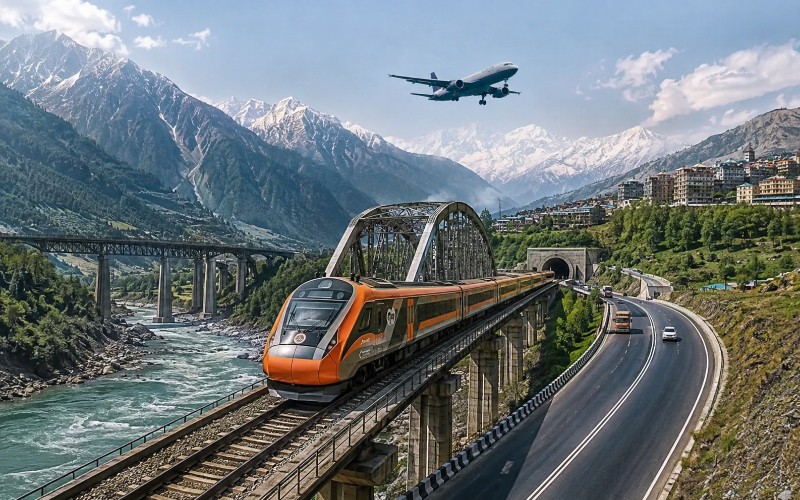
The completion and inauguration of the 272-kilometre Udhampur-Srinagar-Baramulla Rail Link in June 2025 connected the Kashmir Valley with the wider Indian railway network.
The Chenab Rail Bridge and Anji Bridge emerged as landmark engineering elements of the corridor, while Vande Bharat services introduced a faster passenger connection between the Valley and the rest of the country.
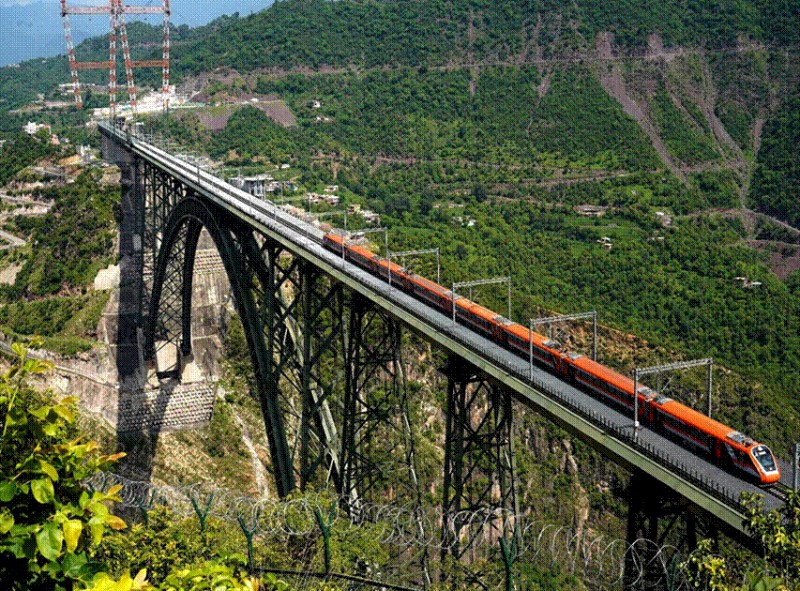 A Vande Bharat train is crossing the Chenab rail bridge, the world's highest railway arch bridge. Photo: PIB
The railway network has continued to expand its role in 2026.
In April, the Jammu-Srinagar Vande Bharat service was extended to Jammu Tawi and its capacity increased from eight to 20 coaches. Regular operations began on May 2, 2026.
The Railway Ministry reported that the trains carried 44,727 passengers during their first ten days of regular operation.
The passenger base included tourists, pilgrims, traders and local residents.
The economic importance of the railway extends beyond passenger movement.
Railway authorities have also highlighted the transportation of Kashmir’s apple produce to markets elsewhere in India, alongside the movement of cement, foodgrains, fertilisers, salt and milk into the Valley.
The railway is therefore becoming a channel for both people and goods, reducing the effects of geographical isolation and strengthening access to national markets.
Tunnels, highways strengthen all-weather connectivity
Rail connectivity forms only one part of the wider infrastructure push.
Road projects are simultaneously changing movement across the Union Territory.
The J&K Economic Survey 2024-25 recorded progress on major projects, including the Jammu Semi Ring Road, while work on the Srinagar Semi Ring Road and other connectivity projects continued.
Tunnel infrastructure is particularly important in a region where terrain and weather have historically affected year-round movement.
A major milestone came in June 2026, when the main tunnel of the Zojila Tunnel project achieved a breakthrough.
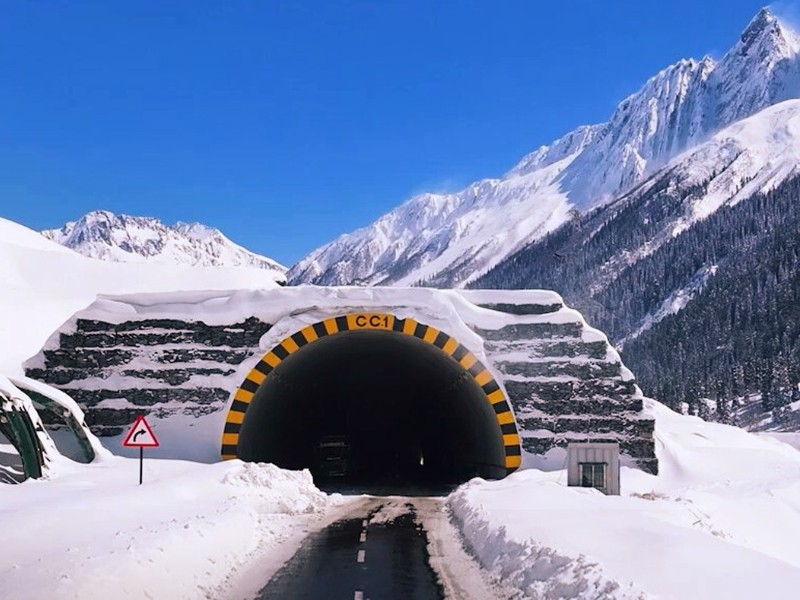 Zojila Tunnel, an under-construction 13.153-km-long road tunnel being built on NH 1 between Baltal in Kashmir and Minamarg in Ladakh. Photo: MyGov
The project is designed to provide all-weather connectivity between Jammu and Kashmir and Ladakh and is expected to strengthen tourism, trade and regional mobility.
The economic effect of such infrastructure extends beyond reducing travel time. Improved roads and tunnels widen the geographical area within which businesses can operate, make markets more accessible and allow visitors to reach destinations that were previously harder to access.
Tourism becomes a larger economic engine
Tourism has become one of the clearest indicators of Jammu and Kashmir’s changing economic profile.
Government data show that the Union Territory recorded more than 2.3 crore tourist arrivals in 2024, the highest number in its recorded history.
The expansion has coincided with improvements in road, rail and aviation connectivity and the growing development of destinations beyond traditional tourist centres.
Aviation infrastructure is also being expanded.
In February 2026, the Cabinet approved the development of a new Civil Enclave at Srinagar International Airport at an estimated cost of ₹1,677 crore.
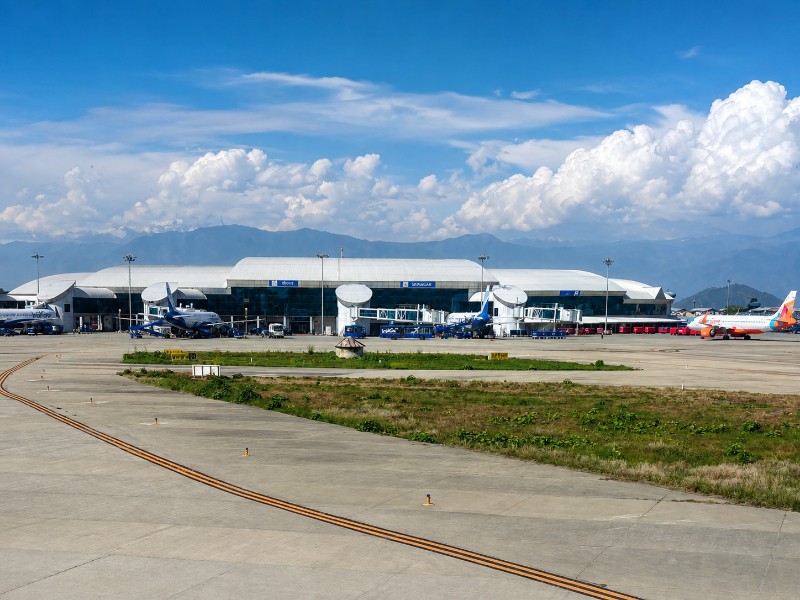 Srinagar International Airport. Photo: Wikimedia Commons/Harvinder Chandigarh
The proposed terminal will cover 71,500 square metres and is designed to handle up to 2,900 passengers during peak hours and 10 million passengers annually.
The importance of tourism extends well beyond hotels and tourist arrivals.
Visitor spending supports transport, hospitality, food services, handicrafts, horticulture and local entrepreneurship, creating economic linkages across several sectors.
Greater railway and airport capacity can also provide businesses, professionals and residents with improved access to markets and destinations outside the Union Territory.
Investment and entrepreneurship expand
Investment provides another indicator of the changing economic environment.
Government data show that Jammu and Kashmir attracted approximately ₹18,000 crore in investment between 2016-17 and 2025-26, compared with around ₹8,000 crore during the preceding seven decades.
The investment push has been accompanied by industrial policies, infrastructure development and measures aimed at improving the business environment.
The Economic Survey 2025-26 notes that new industrial units have become operational and that Jammu and Kashmir achieved a ‘Top Achiever’ ranking in the national assessment of Ease of Doing Business.
Employment and entrepreneurship programmes have also expanded.
Government data indicate that more than 41,000 government jobs were created between 2019 and May 2026, while more than 9.81 lakh people received self-employment opportunities through government-supported schemes during the preceding four years.
The 2026-27 budget places further emphasis on enterprise creation and employment.
Mission YUVA aims to create 1,37,000 enterprises and 4,25,000 jobs over five years through enterprise creation, skill development and employment-related interventions.
Hydropower emerges as a major economic asset
Energy is another important component of Jammu and Kashmir’s development framework.
The Union Territory has significant hydropower potential, making the sector relevant not only to electricity supply but also to industrial activity and government finances.
The 2026-27 budget estimates ₹7,100 crore in non-tax revenue from power, equivalent to 64 percent of the government’s own non-tax revenue.
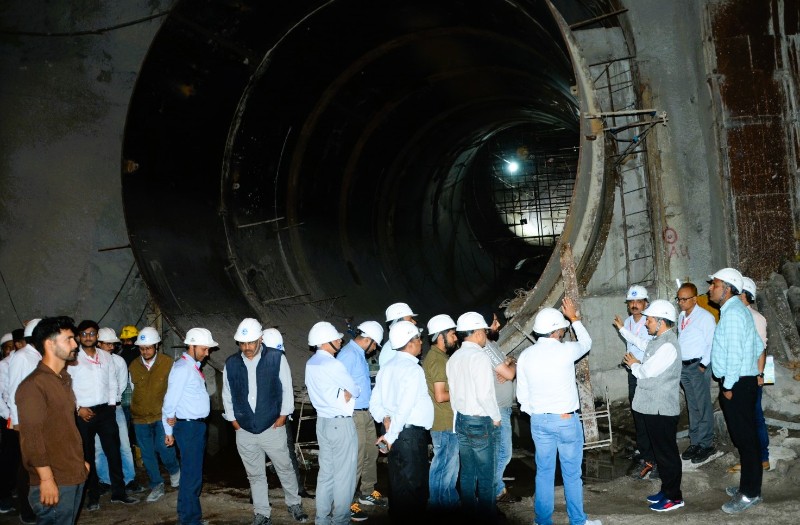 NHPC and RHPCL officials visit the 850 MW Ratle Hydroelectric Project being built on the Chenab River in the Kishtwar district of J&K. Photo: X/@nhpcltd
The J&K Hydro Power Policy 2025 provides a policy framework for expanding the sector and attracting investment in hydropower development.
A larger power ecosystem can support industrial expansion, infrastructure and household demand while allowing Jammu and Kashmir to make greater economic use of one of its most significant natural resources.
Public spending combines infra with social development
The scale of the development push is also reflected in the Union Territory’s budget.
The 2026-27 budget projects GSDP at ₹3,15,822 crore at current prices, representing a 9.5 percent increase over the revised estimate for 2025-26.
Capital outlay is budgeted at ₹25,236 crore, 4 percent higher than the revised estimate for the previous year.
At the same time, spending is not limited to physical infrastructure.
The budget includes measures covering crop insurance, education support, upgraded Anganwadi centres, assistance for vulnerable groups and free public transport for persons with disabilities.
This combination places infrastructure development alongside human-capital and social-sector spending.
Urban services and digital governance add another layer
The development process is also visible in Jammu and Kashmir’s towns and cities.
The Asian Development Bank’s Jammu and Kashmir Urban Sector Development Investment Programme has supported improvements in urban infrastructure and services, with an emphasis on environmentally sustainable and inclusive economic growth.
Improvements in water supply, sanitation and other urban infrastructure complement the wider expansion of transport connectivity.
Digital governance is adding another layer to this process.
The Economic Survey 2025-26 highlights platforms such as BEAMS and GeM as tools for improving transparency, efficiency and accountability in public financial management.
The result is an increasingly interconnected development architecture in which infrastructure, technology, public administration and economic activity operate alongside one another.
Seven years on, connectivity defines the emerging story
Seven years after the Centre revoked the special status, or autonomy, granted under Article 370, the development narrative around Jammu and Kashmir is increasingly being expressed through the language of connectivity and economic integration.
Railways are linking the Valley with national markets, roads and tunnels are strengthening all-weather access, airports are expanding capacity, tourism has reached record levels, and agriculture is moving towards higher-value production and organised markets.
Hydropower is also gaining greater economic importance, while investment and enterprise programmes are opening additional avenues for employment.
From the railway network reaching the Kashmir Valley to the expansion of tunnels, airports, tourism facilities, industrial activity and digital governance, Jammu and Kashmir is becoming more closely integrated with India’s wider economic network.
Support Our Journalism
We cannot do without you.. your contribution supports unbiased journalism
IBNS is not driven by any ism- not wokeism, not racism, not skewed secularism, not hyper right-wing or left liberal ideals, nor by any hardline religious beliefs or hyper nationalism. We want to serve you good old objective news, as they are. We do not judge or preach. We let people decide for themselves. We only try to present factual and well-sourced news.
Support objective journalism for a small contribution.