September 21, 2026 02:55 pm (IST)

Follow us:


SAARC Summit successful, India wants meaningful dialogue with Pak: MEA
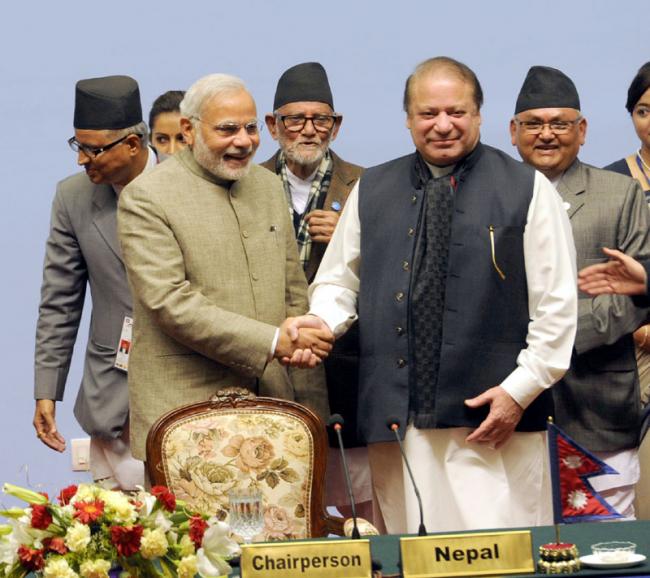
Kathmandu, Nov 27 (IBNS): The Ministry of External Affairs (MEA) on Thursday said Narendra Modi's first participation in the 18th South Asian Association for Regional Cooperation (SAARC) Summit, which came to an end with the Prime Minister shaking hands with his Pakistani counterpart Nawaz Sharif, was a success.
"We concluded it successfully. The Kathmandu Declaration that was put out reflects a broad sense of agreement to re-energies SAARC. The Indian delegation goes back home satisfied," MEA spokesperson Syed Akbaruddin said while addressing the media.
On being asked about the limelight grabbing handshake between the heads of India and Pakistan, the diplomat said the atmosphere was very convivial at the retreat ceremony, adding that "SAARC is not only about Indian and Pakistan."
"The atmosphere was very convivial. When the two PMs came across the first time, they greeted each other and also at the retreat ceremony it was for open display that the two heads of the nation were seen shaking hands," Akbaruddin said.
However, the MEA spokesperson cleared that India wants meaningful dialogue with Pakistan.
"India wants peaceful relationship with Pakistan. We are interested in meaningful dialogues. If this handshake leads to that, then we are ready for it," said he.
Meanwhile, India signed a SAARC Framework Agreement on Energy (Electricity) cooperation on Thursday.
However, the SAARC countries failed to finalise the much-awaited motor vehicle and railway pacts for greater people-to-people contact and movement of goods due to opposition from Pakistan.
While, Modi might not have had a bilateral meet with his Pakistani counterpart, his shaking of hands with Nawaz Sharif at the informal retreat ceremony for SAARC leaders hogged a lot of attention.
According to TV reports and snapshots taken, Modi and Nawaz Sharif not only shook hands but exchanged hellos during the retreat at Dhulikhel, an event that provides an informal setting for discussions over breakfast and lunch.
The development came after Nepali Prime Minister Sushil Koirala appealed the leaders of the two countries should hold talks with each other in an attempt to salvage the derailed summit.
The two heads of state turned cold shoulders to each other since the summit began on Wednesday.
Earlier, in his address in the opening session of the two-day summit, PM Modi had bluntly said SAARC evoked cynicism and skepticism, and offered his suggestions to improve connectivity in the region.
"As SAARC we have failed to move with the speed that our people expect and want. Nowhere in the world are collective efforts more urgent than in South Asia; and, nowhere else is it so modest," he said.
They did not even look at each other when they shared a dais in the opening session.
Modi took part in bilateral talks with every other SAARC nation except Pakistan on Wednesday.
Both sides stood firm saying it was up to the other to request a meeting.
Earlier Pakistan blocked key proposals by India to integrate energy grids and free up road and rail movement forcing the cancellation of a signing ceremony.
Media reported that all eight SAARC leaders expressed frustration with the slow pace of progress towards greater regional integration, which new Afghan President Ashraf Ghani called a failure of political will.
It has been learnt that, to avoid such collapse, Koirala took the initiative to melt the ice.
Analysts dealing on International relations said that, with the cancellation of agreements, countries like Nepal and Afghanistan had to face huge problem at home since there wouldn't have been any development, trade within the SAARC nations.
Koirala rightly assessed that without agreement, India wont be able to involve themselves in Nepal in a larger way.
Trade between them has grown from under $140 million in 2008 to $878 million in 2012, but still accounts for less than five percent of the region`s total commerce.
Despite a free trade agreement signed in 2006, the right nations conduct barely 5 per cent of their total trade with each other.
In its 30-year history, the SAARC has delivered almost negligible results as far as economic ties and development among the eight members - Afghanistan, Bangladesh, Bhutan, India, the Maldives, Nepal, Pakistan and Sri Lanka - is concerned.
Analysts blame their rivalry and poor infrastructure for the very low levels of regional trade among the eight SAARC nations -- Afghanistan, Bangladesh, Bhutan, India, Nepal, the Maldives, Pakistan and Sri Lanka.
The two-day South Asian Association for Regional Cooperation Summit (SAARC) concluded on Thursday evening.
#SAARC Summit successful
# India wants meaningful dialogue with Pak: MEA
# Narendra Modi
# Nawaz Sharif
Support Our Journalism
We cannot do without you.. your contribution supports unbiased journalism
IBNS is not driven by any ism- not wokeism, not racism, not skewed secularism, not hyper right-wing or left liberal ideals, nor by any hardline religious beliefs or hyper nationalism. We want to serve you good old objective news, as they are. We do not judge or preach. We let people decide for themselves. We only try to present factual and well-sourced news.
Support objective journalism for a small contribution.
Latest Headlines
Who is Professor Suryanarayana Doolla? IIT Bombay teacher at centre of Sahil Wakode death row
Mon, Sep 21 2026
IIT Bombay protests erupt after student’s death; authorities meet students over 18 demands
Mon, Sep 21 2026
Baby cockroach crashes cardiologist Ashok Seth’s dinner at Mumbai 5-star; Tukaram Mundhe tagged
Mon, Sep 21 2026
Pune fort murder: Fiancée, lover used fake Instagram account to lure Ketan Agarwal to Lohagad
Sun, Sep 20 2026
Mamata calls Congress 'natural ally' 25 years after giving BJP same tag; her political journey comes full circle
Sun, Sep 20 2026
3 killed, 1 critical as BMW crashes off Mumbai coastal road bridge
Sun, Sep 20 2026