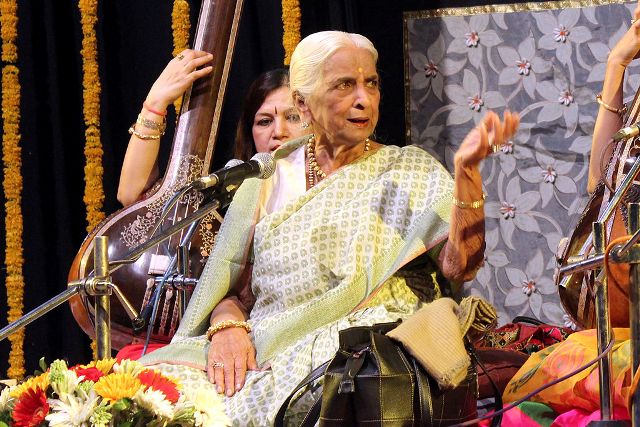
Queen of thumri Girija Devi is no more
Girija Devi, who was conferred the third highest civilian award Padma Vibhushan, was born on May 8 1929. She was a classical singer of the Seniya and Banaras gharanas whose singing of thumri made her a living legend. Thumr is a genre of semi-classical Indian music.
She reportedly died of heart attack. She was suffering from old age ailments. She was admitted in the B M Birla Hospital in Kolkata on Tuesday.
She learnt first under her father ( a landlord) and later took lessons in singing khyal and tappa from vocalist and sarangi player Sarju Prasad Misra starting at the age of five.
She was known as Appa ji popularly.
She first made her public debut in 1949 on All India Radio Allahabad but faced family opposition because in those days women from aristocracy were not encouraged to perform in public.
Later she had her her first public concert in Bihar in 1951.
She was married at the age of 15 to Madhusudan Jain, a businessman of Banaras.
In her website she wrote: "My whole life revolved around the river Ganga and singing. I spent long hours playing on its sandy banks with friends, learning how to swim and catch fish. I would catch a fish, observe it fighting for its life, and let it go. It is amazing to think that I brought the agony of the fish fighting for its life into my music so many years later."
"When I was just fifteen years old, I was married to Shri Madhusudan Jain, a businessman who was truly a lover of music and poetry. I was fortunate to have so much support from my husband. A year after our marriage, we had a baby girl. My husband continued to support my musical career -- but I soon felt the strains and demands of domestic life interfering with my practice."
She said she "once I began experimenting and putting myself into my music, I felt intoxicated by the notes and the music they created."
"Music was like a vast ocean for me. I felt as though I were swimming in it with immense pleasure. For me, music is all that I need in my life."
She said her sincere wish was to continue to learn, grow and to evolve.
Image: Creative Commons/Wikipedia
Support Our Journalism
We cannot do without you.. your contribution supports unbiased journalism
IBNS is not driven by any ism- not wokeism, not racism, not skewed secularism, not hyper right-wing or left liberal ideals, nor by any hardline religious beliefs or hyper nationalism. We want to serve you good old objective news, as they are. We do not judge or preach. We let people decide for themselves. We only try to present factual and well-sourced news.
Support objective journalism for a small contribution.