President of India Kovind presents Visitor’s Awards 2018
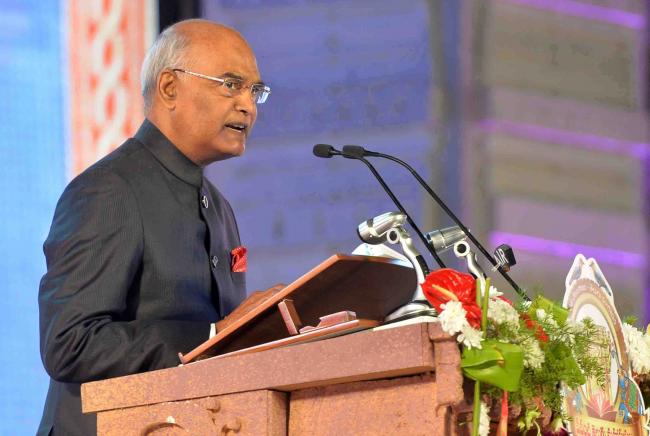
New Delhi, May 2 (IBNS): President of India Ram Nath Kovind, hosted a one-day meet of Vice-Chancellors of Central Universities of whom he is visitor at Rashtrapati Bhavan on Wednesday.
During the inaugural session of the meeting, he presented the Visitor’s Awards for Research in the field of Basic and Applied Science and in the field of Humanities, Arts and Social Science.
Speaking at the award presentation ceremony, the President congratulated the winners of the Visitor’s Awards, 2018.
The awards were presented to Prof. Sanjay K. Jain’s for his work on the development of a drug delivery system having the potential to make cancer treatment more effective and affordable; Prof. Ashis Kumar Mukherjee for his research on the molecular complexicity of the snake venom; Prof. Ashwani Pareek’s work on the development of a rice variety having the potential to enhance the farm productivity and income of farmers; and Prof. Pramod K. Nayar for his work in the field of Humanities, Arts and Social Sciences.
The President said that research and Innovation is the bedrock of advancing knowledge, and knowledge alone holds the key to finding solutions to the problems we face in our world, nation and society.
It is sometimes not understood that research is a demanding profession and a researcher is almost always riding a roller coaster.
Pursuing research demands constant determination from the researcher as well as full institutional support.
Research is not a 9 A.M. to 5 P.M. job and thus our approach towards supporting and promoting a research culture cannot be a pedantic one.
The President said that research and innovation can play an important role in lifting our people out of poverty, ensuring their health and well-being or attaining food and energy security.
Researchers and innovators can help develop solutions to the problems we experience on a daily basis. Universities can also develop mechanisms to support innovation by ordinary people and help such grassroots innovators to further refine their work.
The President said that universities should incorporate community-oriented initiatives in their academic programs and engage with the communities near to their campuses.
Those universities which are located in backward regions have a special responsibility of working with communities around them. Such community initiatives will further expand the horizon of their students and prepare them well for life ahead.
During the day presentations were made by Vice-Chancellors of the central universities on issues relating to promotion of research and innovation in central universities.
Later, addressing the concluding session of the meeting, the President said that universities should play a leading role in addressing the specific challenges faced by our nation. Many of these challenges require creative and innovative solutions. It is their paramount duty to ensure that their campuses emerge as spaces that nurture free expression and ideas, where experimentation is encouraged and failure is not ridiculed but is seen as learning.
In addition, universities should become the conduits for exposing students to the problems faced by our people, our nation, cities, towns and villages.
Through such exposure coupled with a push towards creative and innovative thinking, universities can prepare its students to take up research and innovation projects contributing to national development.
Support Our Journalism
We cannot do without you.. your contribution supports unbiased journalism
IBNS is not driven by any ism- not wokeism, not racism, not skewed secularism, not hyper right-wing or left liberal ideals, nor by any hardline religious beliefs or hyper nationalism. We want to serve you good old objective news, as they are. We do not judge or preach. We let people decide for themselves. We only try to present factual and well-sourced news.
Support objective journalism for a small contribution.