September 24, 2026 06:23 pm (IST)

Follow us:


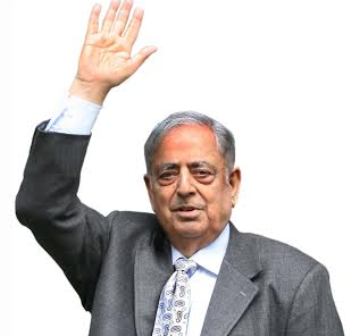
Mufti Mohammad Sayeed: The political survivor returns
When 79-year-old Mufti Mohammad Sayeed assumes the charge as Chief Minister of Jammu and Kashmir for the second time on 1 March 2015, it seems he is destined to be the man for hard times. In 2002 when he became the Chief Minister, with just 16 seats in the State assembly, in alliance with Congress, J&K was reeling under extremely adverse conditions on politico-economic fronts. Personal liberties were severely restricted and Indian Army was in an eye-ball to eye-ball confrontation with Pakistan in the aftermath of the attack on Parliament.
Seen as a visionary leader, a political strategist and masterful politician, Mufti had invited then Prime Minister Atal Bihari Vajpayee to address a rally in Srinagar, first ever for a Prime Minister in nearly two decades, from the PDP stage, triggering a new wave of peace efforts which culminated in withdrawal of forces from forward areas, ceasefire along the borders, disbanding of instruments like STF and SOG, scrapping of POTA and release of political prisoners. It also led to a direct engagement between India and Pakistan and of the Central Government with the separatist leaders in Kashmir.
Mufti’s vision for the State and the region is articulated in PDP’s Self-Rule framework besides suggesting a slew of political measures. He advocates a sub-regional trade arrangement with a Free Trade Zone in Jammu and Kashmir to be implemented under SAFTA or under a separate arrangement between New Delhi and Islamabad.
Mufti believes that facilitating free movement of goods and people through the traditional cross-LoC routes in Jammu and Kashmir would help the policy makers on the two sides of the divide to facilitate the political changes that the people in the region so badly need. He sees opening of Srinagar-Muzaffarabad and Poonch-Rawalakote roads along the LoC as a stepping stone towards forging a new economic alliance in the region.
Within the State, Mufti’s political focus has been on connecting communities and regions into one conglomerate of harmonious diversities. According to PDP, his emphasis on improving the trust levels between two main regions of Kashmir and Jammu has remained the driving force for his party PDP’s political engagement in all the regions and sub-regions that it could emerge as a unifying force that offers channels of aspirations and representation to each one of them.
Mufti after assuming charge as the Chief Minister of J&K in 2002, claimed to have crusaded the “Healing Touch” policy to repair the people’s hurt psyche, salvage their bruised dignity, rekindle a new hope in their hearts and motivate them to mould their destiny through a participatory political process.
After remaining in the Congress for better part of his life Mufti alongwith some likeminded associates and daughter Mehbooba Mufti founded Peoples Democratic Party (PDP) in 1999 and led the first PDP-Congress coalition government in the State from 2002 to 2005.
Early Life
Born in Baba Mohalla in Bijbehara town of district Anantnag on 12 January 1936, Mufti’s early life was typical of the new bourgeoisie that emerged in Kashmir in the middle of the century. Having graduated from S P College in Srinagar, he went on to obtain a degree in law, and a post-graduate degree in Arab History from Aligarh Muslim University.
Although Mufti hoped to gain government employment, he was persuaded by his friends to start a law practice in Anantnag, and to join politics. He joined the Anantnag Bar Association and briefly practiced as a lawyer.
Political Career
In the late 1950s he joined the circle around prominent lawyer and NC leader PL Handoo. He followed Handoo into the breakaway Democratic National Conference (DNC), led by GM Sadiq, alongwith DP Dhar, Syed Mir Qasim and GL Dogra. He was appointed district convener of the new organization, the first formal post he held.
When DNC rejoined NC, Mufti went with the flow. It paid him rich dividends. He was elected to the Assembly from Bijbehara in 1962, and retained the seat in 1967. As a result, he was appointed a Deputy Minister by GM Sadiq.
In 1972 Mufti became a minister in the cabinet headed by Syed Mir Qasim and was also elected the party's leader in the Legislative Council.
In 1975 he was made the leader of the Congress Legislature Party and Pradesh Congress president. He continued to hold the post of PCC chief for over a decade.
In 1986, Mufti was appointed as Union Tourism Minister in the Government headed by then Prime Minister Rajiv Gandhi.
Mufti resigned from the Union Government and Congress following Rajiv-Farooq accord of 1987.
He later joined the Jan Morcha led by VP Singh and was appointed Union Home Minister in 1989, after having won the Lok Sabha elections of that year as the Jan Morcha candidate from Muzaffarnagar in Uttar Pradesh.
In 1989, within few days of taking office as the Union Minister for Home Affairs, his third daughter Rubaiya was kidnapped by terrorists. She was released in exchange for the release of five militants.
Mohammad Sayeed has survived several attacks on his life by Kashmiri separatists who oppose Indian rule.
Mufti returned to J&K politics after having rejoined the Congress in 1996. He won the Anantnag Lok Sabha seat in 1998, but soon resigned from both his position and the party to form the Peoples Democratic Party (PDP).
In 2002, Mufti became Chief Minister of the state. His party PDP won 16 constituencies and formed an alliance with Congress to assume state power from October 2002 to November 2005. PDP was an important ally of United Progressive Alliance-I.
Mufti’s first term as the chief minister of the State between 2002 and 2005, led to significant steps like opening of Srinagar-Muzaffarabad road, initiation of trade and travel across the Line of Control (LoC) without passports and visas with India and Pakistan making some significant concessions on Kashmir.
The prospects of PDP started to shine again in the Lok Sabha election of 2014 when it won all the three seats in Kashmir valley.
Under the astute leadership of Mufti Mohammad Sayeed, PDP has now emerged as a dominant regional political force in Jammu and Kashmir winning 28 seats in 2014 assembly polls with a vote share of 22.7%.
Support Our Journalism
We cannot do without you.. your contribution supports unbiased journalism
IBNS is not driven by any ism- not wokeism, not racism, not skewed secularism, not hyper right-wing or left liberal ideals, nor by any hardline religious beliefs or hyper nationalism. We want to serve you good old objective news, as they are. We do not judge or preach. We let people decide for themselves. We only try to present factual and well-sourced news.
Support objective journalism for a small contribution.
Latest Headlines
Nandigram bypoll shock: Calcutta HC shields Congress candidate Milan Pradhan in 2007 case, but will he walk free?
Thu, Sep 24 2026
‘Resign in 48 hours or face nationwide agitation’: CJP’s ultimatum to Gyanesh Kumar over SIR row
Thu, Sep 24 2026
‘I don’t care if you die’: Driver’s chilling response before Noida bus went up in flames
Thu, Sep 24 2026
Aaditya Thackeray rejects ₹500-crore notice from Disha Salian's father, says 'will not apologise'
Wed, Sep 23 2026
Indian seafarer killed in ship attack off Oman, 19 rescued
Wed, Sep 23 2026