 Rajnath Singh
India's technological sector expected to touch USD 300-350 billion in five years, says Rajnath Singh
Union Defence Minister Rajnath Singh on Monday said India's technological sector is on the rise and is expected to reach 300-350 US billion dollars in the next five years.
Singh said: "With more than 1.25 lakh start-ups and 110 unicorns, our country is emerging as the third-largest start up ecosystem in the world."
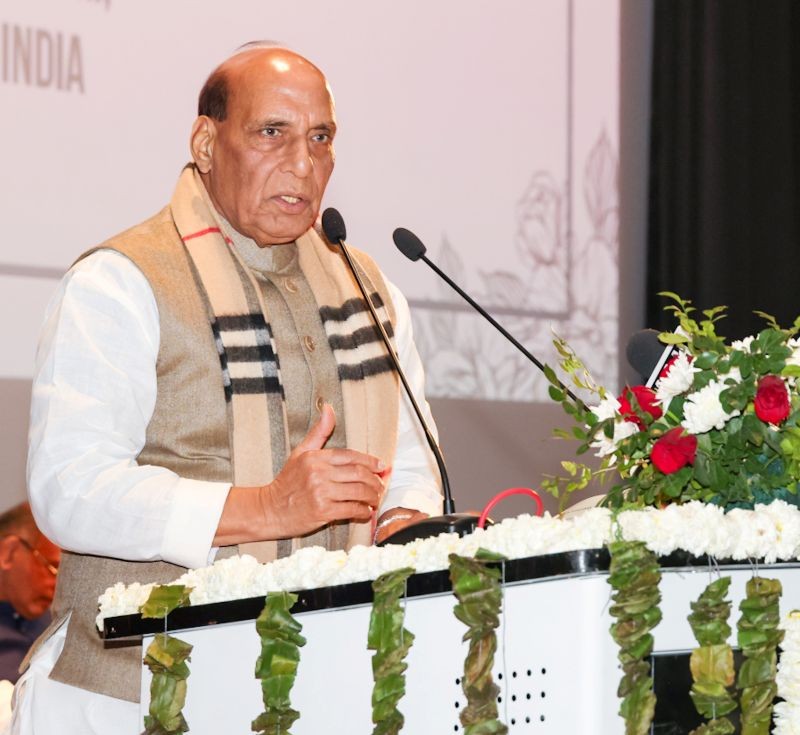
Speaking at the 16th Foundation Day of the Indian Institute of Technology (IIT) Mandi, Himachal Pradesh on February 24, 2025, Singh encouraged the students to leverage this period of growth and opportunity, ensuring that they not only contribute to India’s technological advancements but also lead the way globally in key areas of research and development.
Rajnath Singh emphasised the necessity of innovation and knowledge creation in shaping the future of technology.
Artificial Intelligence
He underscored the importance of fostering a culture of entrepreneurship and innovation that would allow India to lead in emerging fields such as Artificial Intelligence, machine learning, and digital technologies.
He lauded the institution's outstanding contributions to shaping India's technological and scientific advancements.
Singh also highlighted IIT Mandi’s pivotal role in fostering innovation and research, and laid stress on India’s rising prominence as a global leader in technology.
In the context of national security, Rajnath Singh urged IIT Mandi to play a more significant role in defence-related technologies.
He commended the existing collaboration with DRDO and called for further contributions in areas such as Artificial Intelligence (AI)-driven warfare, indigenous AI chip development, cybersecurity, and quantum technology.
Singh also threw light on India’s progress in defence self-reliance, highlighting that “India has achieved 88% self-sufficiency in ammunition production, and defence exports have reached approximately Rs 23,000 crore in 2023-24. Our goal is to reach Rs 50,000 crore in defence exports by 2029.”
He bolstered the government's commitment in creating a robust defence industry in India, one that supports both the security of the nation and contributes to the country’s economic growth.
IIT Mandi
Singh called on IIT Mandi’s students to contribute to this vision by focusing on technological solutions that can enhance India’s defence capabilities and further advance the nation’s self-reliance in this critical sector.
In line with India’s emerging digital economy, Rajnath Singh shared key highlights on the country’s remarkable digital progress.
“India’s telecom sector is now the second-largest in the world. With the success of initiatives like UPI, India is setting global standards in digital transactions. We are in the midst of an unparalleled digital revolution,” he said.
He encouraged the students to actively contribute to the development of India’s digital ecosystem, reiterating that technological innovation is central to India’s growth story in the coming decades.
Rajnath Singh also encouraged the students to be disruptors and not just adapters in the fast-paced world of technology.
“The biggest challenge today is to adapt to the rapidly changing technology, but also to create new technologies. Don’t just be adapters; become the disruptors who lead innovation,” he added.
He spoke about the significant opportunities available to young innovators, stressing the importance of shaping new paradigms rather than simply following existing trends.
Singh further stated that this is the time of the ‘Indian Dream’—a time where the aspirations and achievements can redefine the global landscape.
He motivated the students to set ambitious goals and to aim high in their careers, as their work would have a lasting impact on India’s trajectory in this landscape.
Support Our Journalism
We cannot do without you.. your contribution supports unbiased journalism
IBNS is not driven by any ism- not wokeism, not racism, not skewed secularism, not hyper right-wing or left liberal ideals, nor by any hardline religious beliefs or hyper nationalism. We want to serve you good old objective news, as they are. We do not judge or preach. We let people decide for themselves. We only try to present factual and well-sourced news.
Support objective journalism for a small contribution.